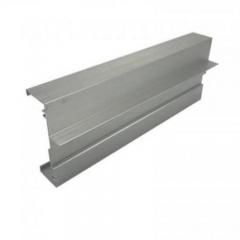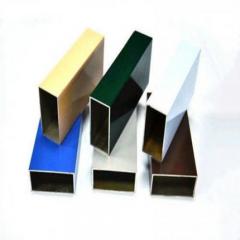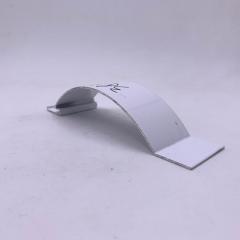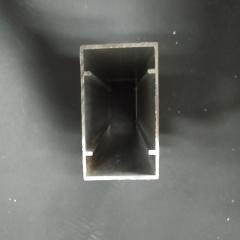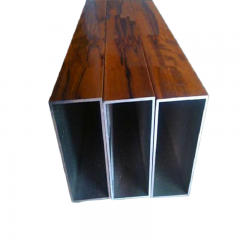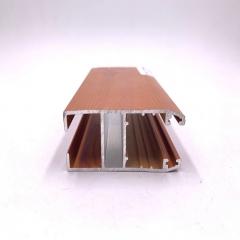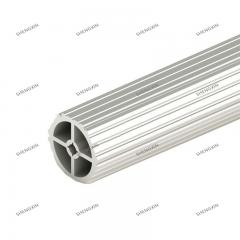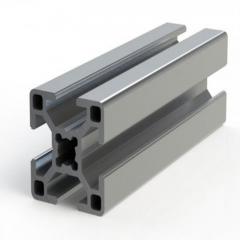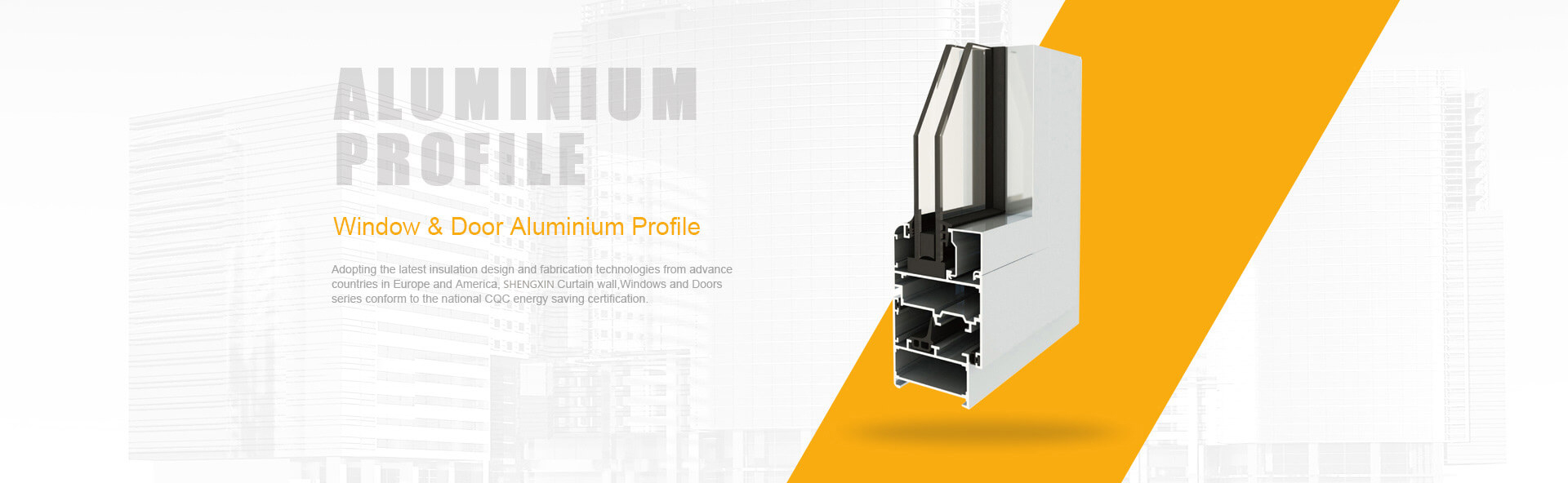
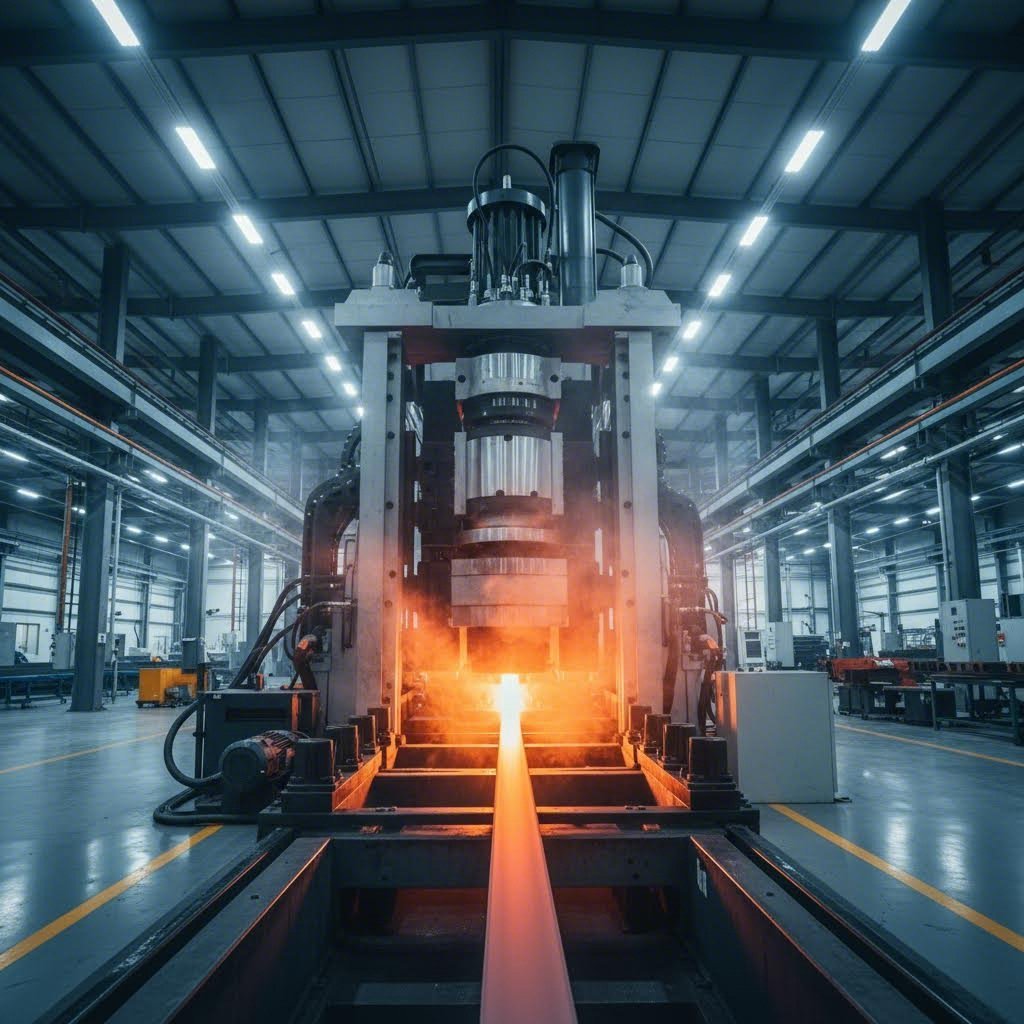
When you're sourcing aluminum extrusions for your next project, one question inevitably comes up: where should you source from? The answer, for many global buyers, points to China. With over 40 million metric tons of aluminum produced annually—accounting for more than half of the world's total output—China has firmly established itself as the epicenter of aluminum profile manufacturing. But what exactly makes china aluminum extrusion manufacturers so dominant in this space?
The story of China's rise in aluminum extrusion didn't happen overnight. Starting in the 1990s, massive government investment and infrastructure development transformed the country's manufacturing landscape. Central and provincial governments provided financial incentives to encourage investment in aluminum smelting and extrusion facilities, while rapid urbanization created enormous domestic demand for aluminum products—from window frames to transportation systems.
By the 2010s, this growth accelerated dramatically. Large-scale smelters emerged in regions like Xinjiang and Inner Mongolia, where energy costs remained lower. Chinese aluminium extrusion manufacturers invested heavily in modern extrusion and casting technologies, enabling them to produce everything from standard profiles to large aluminium extrusions for aerospace, automotive, and construction applications.
Today, the shapes segment alone represents 84.76% of China's aluminum extrusion market revenue, reflecting the industry's sophisticated capabilities in producing complex geometries for diverse applications.
Imagine having access to a manufacturing ecosystem where virtually any aluminum profile—from simple channels to intricate custom shapes—can be produced at scale. That's the reality of working with extruded aluminum manufacturers in China. The country's vertically integrated supply chains create cost efficiencies that are difficult to replicate elsewhere.
What does this mean for you as a buyer? Here are the key advantages of sourcing from Chinese aluminum extrusion suppliers:
The Chinese aluminum extrusion industry has also demonstrated remarkable resilience. While global manufacturing operations faced disruptions during recent years, China bounced back quickly, maintaining its position as the go-to source for international buyers seeking reliable aluminum profile manufacturing partners.
Of course, navigating this vast market requires knowledge. Understanding how the extrusion process works, which alloys suit your application, and how to evaluate potential suppliers are all critical steps—topics we'll explore in detail throughout this guide.
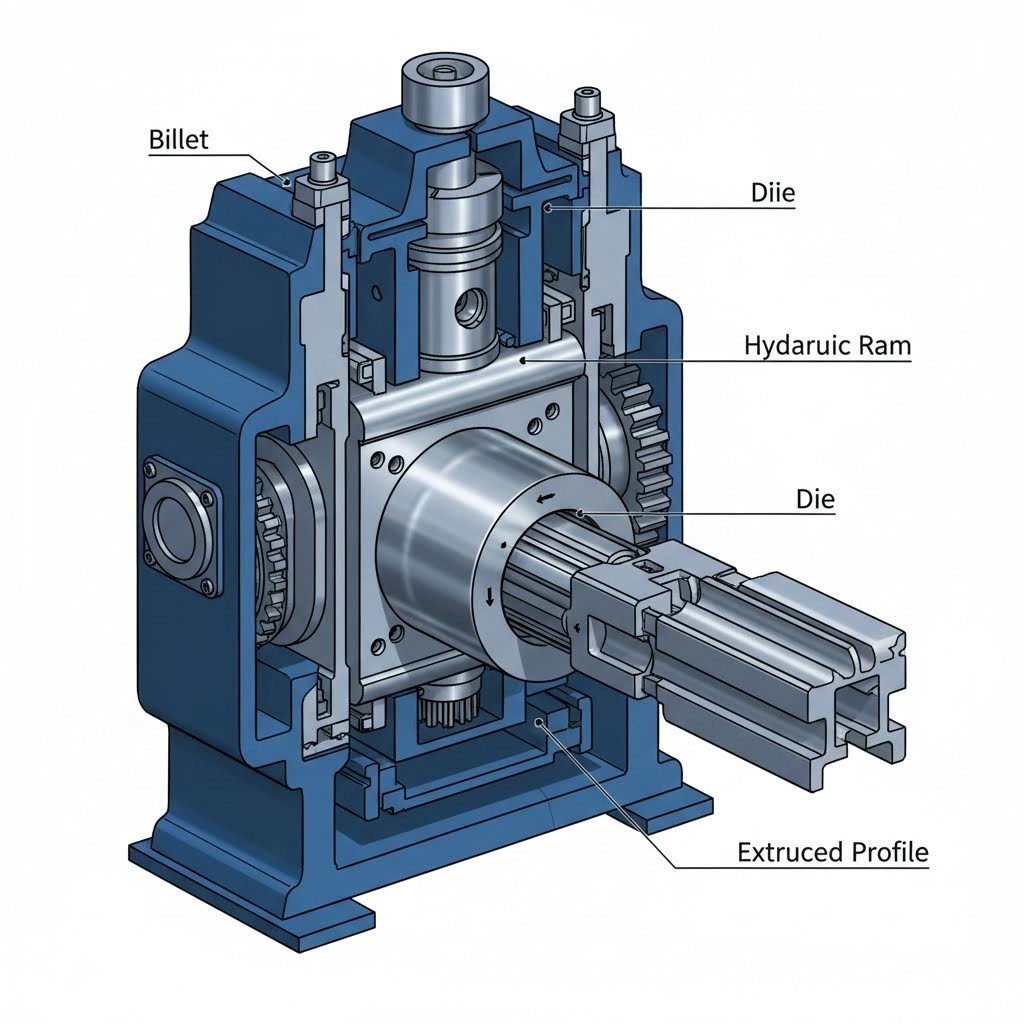
Ever wondered how a solid chunk of aluminum transforms into the precise profiles used in your products? Understanding the extrusion process gives you a significant advantage when communicating with China aluminum extrusion manufacturers. You'll know the right questions to ask, recognize quality indicators, and better evaluate supplier capabilities.
At its core, aluminum extrusion works like a sophisticated play-doh press. A heated aluminum billet is forced through a specially designed die under immense pressure, emerging as a continuous profile with the exact cross-section of the die opening. Sounds simple? The reality involves multiple controlled variables—alloy selection, billet temperature, die design, ram speed, and quench method—all affecting the final product's properties.
The journey from raw material to finished aluminum extrusions shapes begins with a cylindrical billet—essentially a solid aluminum log. This billet, typically composed of your specified alloy, enters a precisely controlled manufacturing sequence that determines everything from dimensional accuracy to mechanical strength.
Here's the complete workflow you should understand:
When evaluating aluminum extruder suppliers, press tonnage tells you a lot about their capabilities. Chinese manufacturers operate presses ranging from 600T for simple, small-cross-section profiles to massive 5500T machines for complex industrial shapes.
Why does this matter? Consider these applications:
The extrusion die deserves special attention. This precision tool—typically machined from H13 tool steel—directly determines your profile's shape, surface quality, and dimensional accuracy. For custom profiles, die development involves CAD design, finite element analysis for material flow optimization, and careful bearing length calculations to ensure uniform extrusion speed across the profile.
A well-designed die can produce thousands of tons of profile before requiring maintenance, while a poorly designed one may fail prematurely or produce inconsistent results.
When requesting quotes from manufacturers, ask about their die development capabilities and lead times. Custom dies typically add 2-4 weeks to your timeline and represent a one-time tooling investment that can range from a few hundred to several thousand dollars depending on complexity.
Understanding these manufacturing fundamentals prepares you for the next critical decision: selecting the right aluminum alloy for your specific application requirements.
Here's a truth that many buyers discover too late: the aluminum alloy you choose affects everything—from how your profile performs under stress to what you'll pay and how long you'll wait. Yet when reviewing quotes from china aluminum extrusion manufacturers, alloy selection often gets reduced to a simple line item. Let's change that.
Aluminum alloys combine pure aluminum with elements like magnesium, silicon, zinc, and copper. These additions fine-tune the metal's strength, corrosion resistance, and machinability. Understanding these differences helps you specify the right material from the start—avoiding costly redesigns or performance failures down the road.
Think of aluminum alloy selection as matching a tool to a job. You wouldn't use a sledgehammer to hang a picture frame, right? Similarly, specifying 7075 aluminum extrusion for a simple window frame wastes money, while using 6063 for aircraft structural components creates dangerous safety risks.
The alloy series number tells you the primary alloying element:
When sourcing aluminium tube stock or square aluminium extrusion profiles, you'll most commonly encounter 6063 and 6061. These two alloys account for the vast majority of extruded products globally—but they serve distinctly different purposes.
Alloy 6063 is the default choice for architectural applications. Its excellent surface finish, good corrosion resistance, and superior extrudability make it perfect for window frames, door systems, and decorative trim. If you're ordering anodized extruded aluminum for visible applications, 6063 typically delivers the smoothest, most consistent finish.
But what happens when your application demands more? Consider these scenarios:
Here's a practical comparison to guide your decision:
| Property | 6063-T5/T6 | 6061-T6 | 7075-T6 | 5052-H32 |
|---|---|---|---|---|
| Tensile Strength | 27,000-35,000 PSI | 42,000-45,000 PSI | 83,000 PSI | 33,000 PSI |
| Corrosion Resistance | Excellent | Good | Moderate | Excellent |
| Weldability | Good | Excellent | Poor | Excellent |
| Extrudability | Excellent | Good | Difficult | Good |
| Surface Finish | Excellent | Good | Good | Good |
| Relative Cost | $ | $$ | $$$ | $$ |
| Typical Applications | Window frames, architectural trim, furniture | Structural frames, machine parts, automotive | Aerospace, defense, high-stress components | Marine equipment, fuel tanks, pressure vessels |
How does alloy choice affect your sourcing experience? Several ways:
When specifying aluminium square tube sizes or other profiles, always confirm the alloy's temper designation (like T5 or T6) alongside the alloy number. The temper indicates heat treatment and directly affects mechanical properties—a 6061-T4 profile has significantly different characteristics than 6061-T6.
With your alloy selected, the next consideration becomes equally important: what surface finish will protect and enhance your aluminum profile for its intended environment?
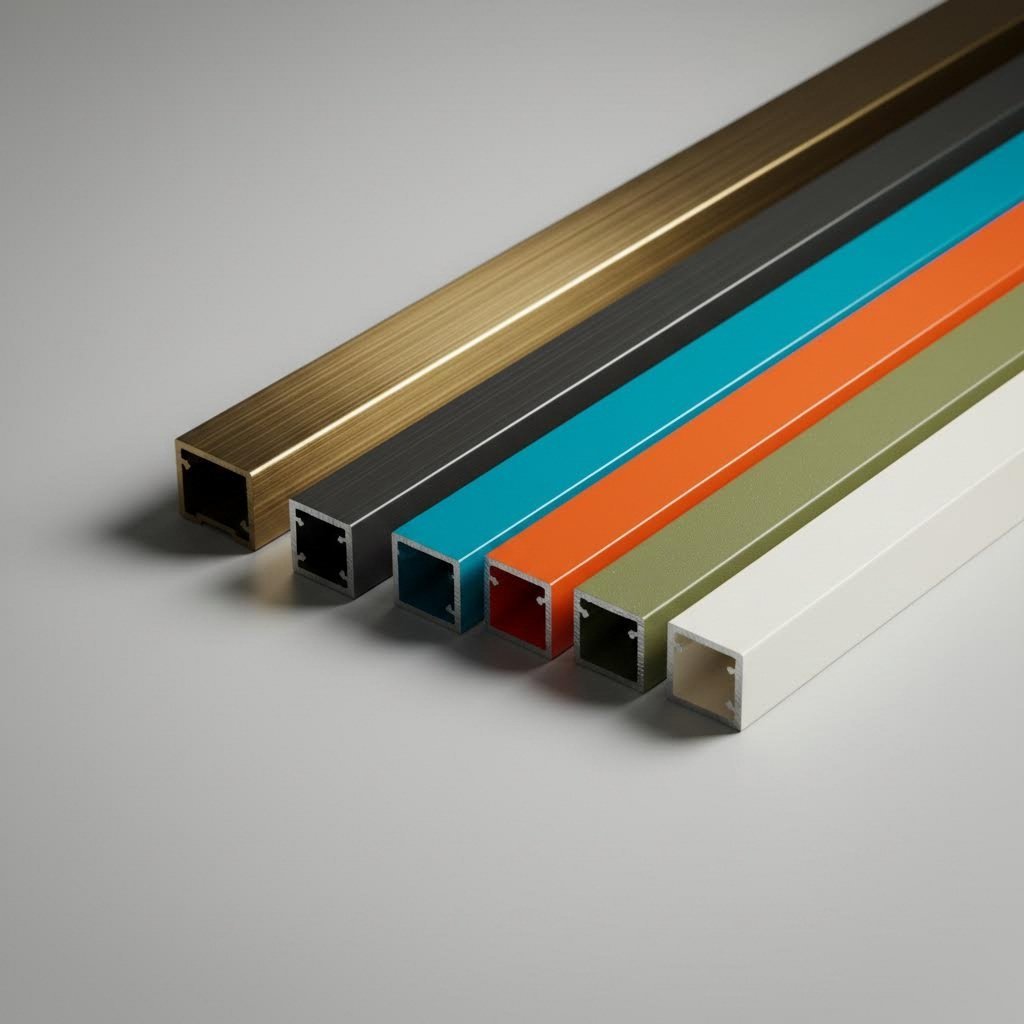
You've selected your alloy and designed your profile—but here's where many buyers stumble. The surface finish you specify can make or break your product's performance, appearance, and longevity. Whether you're sourcing aluminium window extrusions for a coastal building or industrial frames for factory automation, understanding your finishing options helps you communicate precisely with china aluminum extrusion manufacturers.
The good news? Chinese manufacturers offer a comprehensive range of surface treatments—from basic mill finishes to sophisticated multi-layer coating systems. The key is matching the right finish to your specific application and environment.
Let's explore the primary finishing technologies available from Chinese aluminum extrusion suppliers:
Anodizing remains the most popular finish for aluminum window profiles and architectural applications. Unlike paint or powder coating, anodizing doesn't apply an external product to the surface. Instead, an electrochemical process thickens the aluminum's natural oxide layer, creating an integral protective barrier that cannot peel or flake.
What makes anodizing particularly attractive for aluminium window frame extrusions? The process offers:
For aluminum window frame material exposed to high-traffic areas like storefronts, anodizing's superior abrasion resistance makes it the preferred choice over paint.
Powder Coating delivers vibrant, long-lasting colors with excellent UV resistance. The process applies dry paint powder electrostatically, then bakes the coated profiles to create an even, durable finish. When you need a mirror profile effect or specific RAL colors for custom aluminum tile trim applications, powder coating offers virtually unlimited color possibilities.
PVDF Coating (Polyvinylidene Fluoride) represents the premium choice for exterior architectural applications. These resin-based coatings, applied in factory settings, provide exceptional resistance to fading, chemicals, and weathering. PVDF-coated aluminum window profiles can maintain their appearance for decades, even in harsh coastal or urban environments.
Micro-Arc Oxidation (MAO) creates ceramic-like coatings significantly harder than conventional anodizing. This advanced treatment produces surfaces with excellent thermal stability and wear resistance—ideal for industrial applications requiring extreme durability.
Your application environment should drive your finish selection. Here's a practical comparison to guide your decision:
| Finish Type | Durability | Relative Cost | Color Options | Best Applications |
|---|---|---|---|---|
| Clear Anodizing (Class I) | 20+ years exterior | $$ | Natural aluminum tones | Storefronts, handrails, high-traffic areas |
| Color Anodizing | 15-20 years exterior | $$-$$$ | Bronze, black, champagne, gold tones | Architectural facades, decorative trim |
| Powder Coating | 10-15 years exterior | $$ | Unlimited RAL colors, textures | Interior furniture, equipment enclosures |
| PVDF Coating | 20-30 years exterior | $$$ | Wide color range, matte finishes | Curtain walls, metal roofing, coastal buildings |
| Micro-Arc Oxidation | Exceptional hardness | $$$$ | Limited (gray, black) | Industrial machinery, high-wear components |
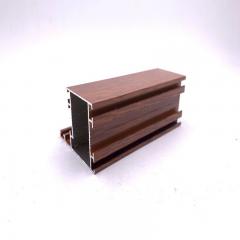
| Sublimation (Wood Grain) | 10-15 years exterior | $$$ | Wood patterns, stone effects | Pergolas, outdoor furniture, window frames |
When specifying finish requirements in your RFQ, be explicit about these factors:
Here's an important consideration: surface treatment capabilities vary significantly between manufacturers. Some specialize in architectural finishes with sophisticated color-matching systems, while others focus on industrial coatings optimized for durability over aesthetics. When evaluating potential suppliers, ask specifically about their finishing equipment, quality control processes, and experience with your required treatment type.
A manufacturer producing beautiful aluminium window extrusions might not have the capabilities for the advanced ceramic coatings your industrial application requires—and vice versa. Aligning your finish requirements with supplier specializations ensures you're working with partners equipped to deliver exactly what your project demands.
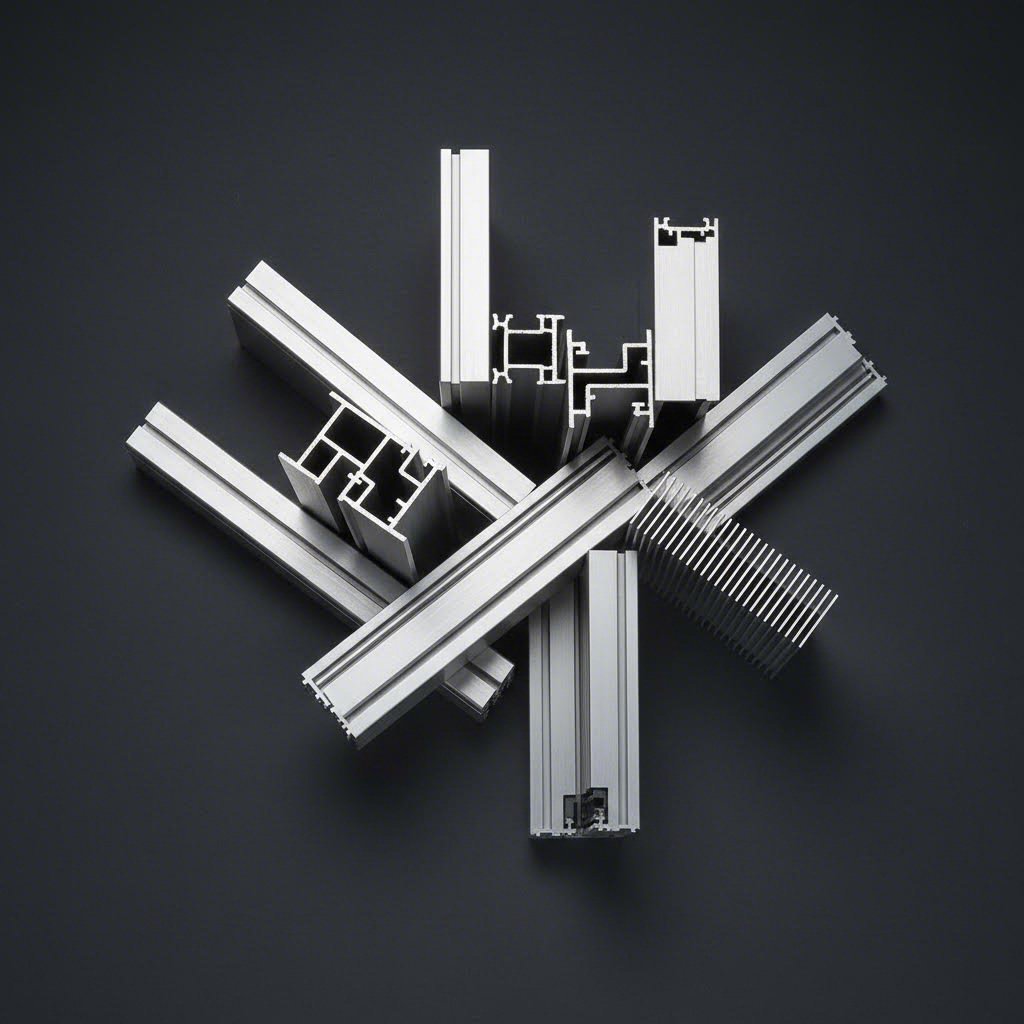
With your alloy and surface finish decisions made, here's the next question: what profile shape do you actually need? China aluminum extrusion manufacturers produce an astonishing variety of cross-sectional geometries—from simple angles and channels to complex custom shapes designed for specific applications. Understanding this landscape helps you identify suppliers whose expertise aligns with your industry requirements.
Think of aluminum profiles as building blocks that serve vastly different purposes depending on their design. An extruded aluminum window frame demands different characteristics than a v slot aluminium extrusion for a CNC machine. Let's break down the major categories and their applications.
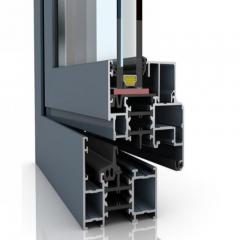
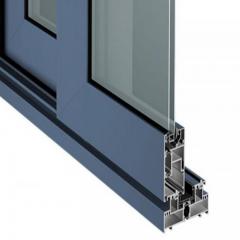
Architectural profiles prioritize aesthetics alongside function. These extrusions form the visible framework of buildings—the window and door systems, curtain wall mullions, and decorative elements that define a structure's appearance. When sourcing architectural aluminum, you're typically looking for:
Industrial profiles, by contrast, emphasize mechanical performance over appearance. These workhorse extrusions build automation systems, machine frames, and structural assemblies where strength, modularity, and precision matter most:
The difference in manufacturing approach is significant. Architectural suppliers typically maintain extensive finishing capabilities—anodizing lines, powder coating booths, and wood-grain sublimation systems. Industrial-focused manufacturers often invest more heavily in precision machining, tight tolerance control, and specialized alloy processing.
Beyond standard categories, aluminum extrusion technology enables remarkably complex custom geometries. This is where the process truly shines—almost any cross-sectional shape imaginable can be produced through custom die design.
Common specialty profiles include:
Here's a practical overview of profile applications by industry sector:
| Industry Sector | Common Profile Types | Key Requirements |
|---|---|---|
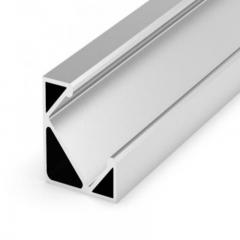
| Construction & Architecture | Window frames, curtain walls, doors, aluminum corner extrusion | Surface quality, thermal performance, weather resistance |
| Industrial Automation | V slot extruded aluminum, T-slot framing, aluminium h channel | Dimensional precision, modularity, load capacity |
| Solar & Renewable Energy | Panel mounting rails, frame profiles, support structures | Corrosion resistance, structural integrity, cost efficiency |
| Transportation | Body panels, structural members, interior trim | Weight optimization, crash performance, tight tolerances |
| Electronics & LED | Heat sinks, enclosures, mounting channels | Thermal conductivity, precise machining compatibility |
| Furniture & Display | Modular frames, aluminum hat channel, decorative sections | Aesthetic finish, assembly ease, design flexibility |
Why does manufacturer specialization matter to you? Consider this: a supplier focused on architectural aluminum window profiles maintains different equipment, expertise, and quality systems than one producing v slot aluminium extrusion for the automation industry. The architectural specialist understands thermal break assembly, glazing requirements, and facade certification standards. The industrial specialist knows tight tolerance control for linear motion systems and modular assembly optimization.
When you approach suppliers, ask about their primary market focus. Request examples of similar projects they've completed. A manufacturer producing thousands of tons of solar panel frames annually has refined processes for that specific application—but may lack experience with the complex geometries required for triangular aluminum extrusion or curved architectural elements.
This industry alignment becomes even more critical when you move beyond basic profiles to evaluate the complete package of capabilities, certifications, and services that distinguish reliable partners from basic commodity suppliers.
You've defined your profile requirements, selected your alloy, and identified the finish you need. Now comes the decision that determines whether your project succeeds or becomes a sourcing nightmare: choosing the right aluminium profile manufacturer. This step separates experienced buyers from those who learn expensive lessons the hard way.
Here's the reality most supplier directories won't tell you: production capacity alone means nothing. A manufacturer with fifty extrusion presses can still deliver poor-quality profiles, miss deadlines, and create communication headaches. The evaluation criteria that actually matter go far deeper—and understanding them gives you a significant advantage when vetting china aluminum extrusion manufacturers.
Think of supplier evaluation like hiring a key employee. You wouldn't hire someone based solely on their claimed experience—you'd verify credentials, check references, and assess their fit with your specific needs. The same discipline applies when selecting a custom aluminum extrusion manufacturer.
Certifications tell you what standards a manufacturer actually meets. ISO 9001 certification indicates the supplier has established a systematic approach to quality management, ensuring your requirements are clearly understood, agreed upon, and fulfilled. But here's what many buyers miss: different industries demand different certifications.
When sourcing aluminum window frame extrusions for commercial buildings, ISO 9001 typically suffices. But if you're producing components for aircraft or defense applications, AS9100 certification isn't just preferable—it's non-negotiable.
Use this comprehensive framework when evaluating potential aluminum profile manufacturers:
| Evaluation Category | Key Questions to Ask | What Good Looks Like |
|---|---|---|
| Certifications | Which quality certifications do you hold? When was your last audit? | Current ISO 9001 minimum; industry-specific certs (IATF 16949, AS9100) when applicable; willingness to share audit reports |
| Equipment Capabilities | What is your press tonnage range? How many CNC machining centers do you operate? | Press range matching your profile complexity (600T-5500T); modern CNC equipment for secondary processing; aging furnaces for proper heat treatment |
| Surface Treatment | Which finishing processes do you perform in-house? | In-house anodizing lines, powder coating booths; color-matching capabilities; clear quality standards for finish specifications |
| Quality Control | What inspection equipment do you use? What is your defect rate? | CMM machines, spectrometers for alloy verification; documented inspection procedures; willingness to share quality metrics |
| Minimum Order Quantities | What are your MOQs for custom dies? For repeat orders? | Flexible MOQs (500kg-1 ton typical for custom profiles); clear explanation of why minimums exist |
| Communication | Who will be my primary contact? What is your typical response time? | Dedicated English-speaking project manager; responses within 24 hours; proactive updates on order status |
| Experience | How long have you been producing profiles for my industry? Can you share references? | Documented experience with similar applications; willing to provide customer references; portfolio of comparable projects |
Equipment capabilities reveal manufacturing sophistication. When a supplier describes their press range, they're telling you what profile complexity they can handle. A manufacturer operating presses from 600T to 5500T can produce everything from simple aluminum window extrusion profiles to massive structural sections. But presses alone don't complete the picture—ask about:
Experienced buyers develop a sixth sense for warning signs. After evaluating hundreds of extruded aluminium suppliers, certain patterns consistently predict future problems. Watch for these red flags:
Reluctance to provide samples. A confident manufacturer welcomes the opportunity to demonstrate quality. If a supplier deflects sample requests, charges excessive fees, or provides excuses about why samples aren't possible, question what they're hiding. Quality suppliers understand that samples build trust and lead to larger orders.
Vague quality control descriptions. When you ask about inspection procedures, evasive answers should trigger concern. Reputable suppliers can explain exactly how they monitor quality, what equipment they use, and what metrics they track. Phrases like "we check everything" without specifics suggest informal or inconsistent quality systems.
No factory audit options. Legitimate manufacturers welcome factory visits or third-party audits. If a supplier actively discourages on-site verification, ask yourself why. The pandemic made virtual factory tours commonplace—suppliers should offer video walkthrough options if in-person visits aren't feasible.
Additional warning signs to monitor:
According to industry research, more than 80% of OEM problems evolve from supply chain quality or delivery issues. Thorough supplier vetting isn't paranoia—it's essential risk management.
Before finalizing your supplier selection, conduct proper due diligence. Request references from existing customers in your industry and actually call them. Ask about on-time delivery rates, quality consistency, and how problems were handled when they occurred. A supplier's response to issues often matters more than whether issues arise in the first place.
With your evaluation framework in place, you're ready to navigate the practical aspects of working with Chinese manufacturers—from understanding realistic MOQ expectations to managing lead times and pricing negotiations.
You've identified promising suppliers and understand what separates quality manufacturers from commodity producers. Now comes the practical reality of actually placing orders with china aluminum extrusion manufacturers. This is where cultural differences, logistical complexities, and communication challenges can derail even well-planned sourcing projects—if you're not prepared.
The good news? International buyers successfully source aluminum extrusions from China every day. The key lies in understanding realistic expectations for minimum orders, lead times, and pricing—then building communication systems that prevent misunderstandings before they occur.
Let's address the question every buyer asks first: how much do I need to order? Minimum order quantities from Chinese aluminium extrusion suppliers typically fall into predictable ranges based on whether you're ordering custom or standard profiles.
For custom dies and profiles, expect MOQs between 500kg and 1 ton of finished extrusion per profile design. Why this range? Die manufacturing represents a significant fixed cost that manufacturers must amortize across production volume. If you have a die cost of USD $2,000 and expect to extrude 20,000 kg through that die, the tooling cost per kg is $0.10. If you only produce 2,000 kg, the per-kg tooling cost becomes $1.00. Manufacturers set MOQs to ensure orders make economic sense for both parties.
For stock aluminium extrusion profiles—standard shapes that manufacturers keep in regular production—MOQs often drop significantly. Some aluminum extruder suppliers offer standard profiles with minimums as low as 200-300kg, since no custom tooling investment is required.
Lead times follow a predictable pattern once you understand the production sequence:
For a complete custom order including die development, surface treatment, and basic machining, plan for 6-10 weeks from order confirmation to shipment. Repeat orders using existing dies can often ship in 3-5 weeks.
When you receive quotes from extruded aluminum profiles suppliers, the numbers reflect multiple cost components working together. Understanding these factors helps you negotiate effectively and avoid surprise costs.
The primary factors affecting your per-kilogram or per-meter pricing include:
When comparing quotes from different aluminium extruded profiles suppliers, ensure you're comparing equivalent specifications. A lower per-kilogram price means nothing if it excludes surface treatment your application requires or uses a lower-quality alloy.
Effective communication prevents the misunderstandings that plague international sourcing. When working with Chinese manufacturers, clear documentation becomes your most valuable tool.
Technical drawings are non-negotiable. Provide detailed CAD drawings with complete dimensioning, tolerances, and material specifications. Don't assume anything is obvious—explicitly state alloy grade, temper, surface finish requirements, and acceptable tolerance ranges. Drawings should include:
For anodized aluminum tubing suppliers or any finish-critical applications, include color samples or RAL numbers. Visual standards prevent disputes about acceptable appearance.
Language considerations matter. While many Chinese sales representatives speak English well, technical terminology can create confusion. Use simple, direct language. Avoid idioms or colloquialisms. When discussing critical specifications, request written confirmation and repeat key points in different ways to verify understanding.
Quality inspection and documentation requests should be established before production begins. Request these documents as part of your order agreement:
Consider third-party inspection services for significant orders. Companies specializing in China quality control can verify production quality before shipment, catching issues while correction is still possible.
Establish clear communication channels and expectations upfront. Agree on response timeframes, preferred communication methods (email, WeChat, video calls), and escalation procedures for urgent issues. A dedicated project manager on the supplier side significantly improves communication consistency.
With these practical foundations in place, you can focus on what truly differentiates leading manufacturers: their ability to deliver comprehensive value-added services beyond basic extrusion.
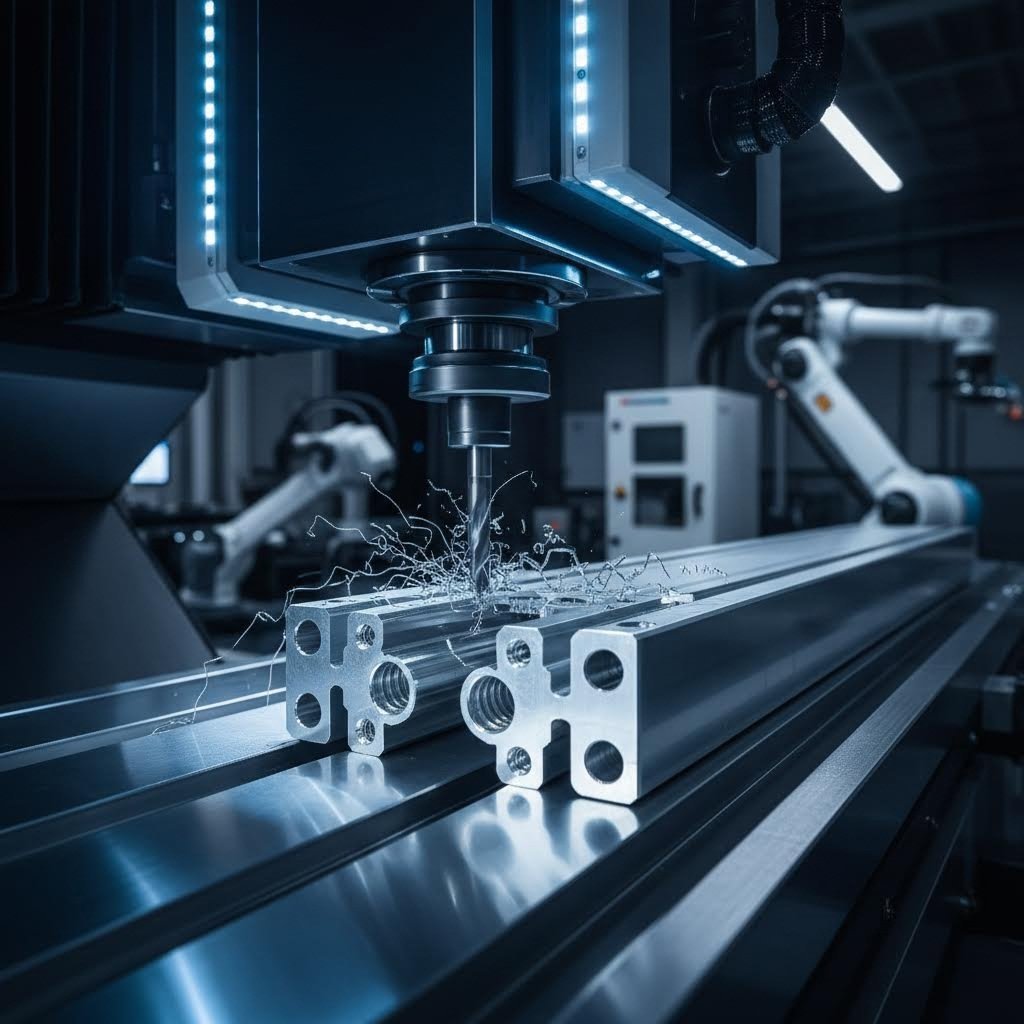
Here's what separates a basic aluminum extruder from a true manufacturing partner: the ability to deliver finished components—not just raw profiles. When evaluating china aluminum extrusion manufacturers, understanding their deep processing capabilities can dramatically simplify your supply chain and reduce your total project cost.
Think about it this way: receiving raw extrusions means you'll need additional vendors for cutting, drilling, machining, and assembly. Each handoff introduces potential quality variations, lead time delays, and coordination headaches. Manufacturers offering comprehensive value-added services eliminate these friction points entirely.
Modern aluminum extrusion facilities have evolved far beyond simply pushing metal through dies. CNC machining technology enables precise material removal from aluminum workpieces to create specific shapes and features that extrusion alone cannot achieve. Leading manufacturers now integrate sophisticated processing centers that transform raw profiles into ready-to-install components.
The primary deep processing services you should evaluate include:
For profiles requiring negative spaces or features impossible to achieve through extrusion—such as cross-drilled holes through aluminium extrusion box sections or oval extruded aluminum profiles with machined mounting surfaces—these secondary operations become essential rather than optional.
Not every project requires deep processing. Simple applications using standard aluminium extruded tubes cut to length may only need basic sawing services. But several scenarios make comprehensive manufacturing partnerships invaluable:
Consider a manufacturer like Shengxin Aluminium, which exemplifies the comprehensive service model. Their facility houses 35 extrusion presses ranging from 600T to 5500T, providing the capacity to produce everything from delicate trim profiles to massive structural sections. But what truly differentiates their operation is the integration of CNC machining centers that handle precision cutting, drilling, and bending—all under one roof.
This end-to-end capability means technical support extends from initial die development through mass production. Rather than coordinating between separate extrusion and machining vendors, buyers work with a single team that understands how upstream decisions affect downstream processing. The result? Fewer surprises, faster turnarounds, and components that arrive ready for installation.
When requesting quotes, ask potential suppliers specifically about their deep processing equipment and capacity. A manufacturer with modern 5-axis CNC equipment can produce features that older 3-axis machines simply cannot achieve. Similarly, in-house powder coating and welding capabilities—rather than outsourced finishing—typically indicate more sophisticated quality control and faster lead times.
The value-added services question ultimately comes down to your own capabilities and strategic priorities. If your core competency lies in product design and marketing rather than fabrication, partnering with a manufacturer offering comprehensive processing makes sense. If you maintain extensive in-house machining capacity, sourcing raw extrusions may prove more cost-effective.
With your understanding of manufacturing capabilities now complete, the final step is developing a concrete action plan for moving forward with your sourcing project.
You've now explored the complete landscape of sourcing from china aluminum extrusion manufacturers—from understanding manufacturing processes and alloy selection to evaluating suppliers and negotiating practical terms. The question remains: how do you translate this knowledge into action?
Successful aluminum sourcing isn't about finding the cheapest quote or the biggest factory. It's about identifying aluminum profile manufacturers whose capabilities, specializations, and service quality align with your specific project requirements. Let's synthesize everything into a practical roadmap you can follow.
Whether you're ordering architectural window extrusion profiles for a construction project or industrial frames for automation equipment, following a structured approach prevents costly mistakes and accelerates your timeline. Here's your step-by-step framework:
The manufacturer you choose becomes more than a vendor—they become an extension of your production capability. This relationship matters especially when you need technical support throughout the project lifecycle, from initial design consultation through ongoing production runs.
For buyers seeking a reliable starting point, Shengxin Aluminium represents the comprehensive service model that simplifies international sourcing. With over 30 years of industry experience and 35 extrusion presses spanning 600T to 5500T capacity, their operation handles everything from custom 6063 aluminum tubes to complex industrial profiles and architectural aluminium window extrusions suppliers typically struggle to produce.
What distinguishes a manufacturer like Shengxin is their end-to-end support model. Their technical team assists from die development through mass production, ensuring your specifications translate into quality components. In-house CNC machining centers handle precision cutting, drilling, and bending—meaning you receive ready-to-install parts rather than raw profiles requiring additional processing. Factory-direct pricing eliminates middleman markups while maintaining the quality control that comes from integrated manufacturing.
Choosing manufacturers who provide technical support throughout the project lifecycle—not just during the sales process—dramatically reduces sourcing risk and improves outcomes.
As you move forward, keep these principles in mind:
The Chinese aluminum extrusion industry offers unmatched capabilities, competitive pricing, and sophisticated manufacturing technology. By applying the evaluation frameworks and practical guidance covered throughout this guide, you're positioned to navigate this landscape confidently—transforming what could be a complex sourcing challenge into a straightforward path toward quality components at competitive prices.
Ready to explore your options? Start by defining your specifications, then reach out to manufacturers whose specializations match your needs. Your next successful aluminum extrusion project begins with that first informed conversation.
Zhongwang Aluminum is Asia's largest aluminum extrusion producer and among the most technically advanced globally. They serve aerospace, automotive, and marine industries with high-performance alloy applications. Other major players include JMA Aluminum (established 1993), Fenglu Aluminum, and Shengxin Aluminium with over 30 years of experience and 35 extrusion presses ranging from 600T to 5500T capacity.
For custom profiles requiring new die development, MOQs typically range from 500kg to 1 ton per profile design. This ensures die manufacturing costs are economically distributed across production volume. For standard stock profiles that manufacturers keep in regular production, minimums can drop to 200-300kg since no custom tooling investment is required.
Complete custom orders typically require 6-10 weeks from order confirmation to shipment. This includes die development (2-4 weeks), extrusion production (1-3 weeks), surface treatment (1-2 weeks), and secondary processing if needed (1-2 weeks). Repeat orders using existing dies can ship in 3-5 weeks since die development time is eliminated.
ISO 9001 certification is the baseline quality management standard every reputable supplier should hold. For automotive applications, require IATF 16949 certification. Aerospace components demand AS9100 certification with rigorous risk management protocols. Additionally, ISO 14001 environmental certification is increasingly important for sustainability-focused buyers.
6063 is ideal for architectural applications with excellent surface finish and extrudability, offering tensile strength of 27,000-35,000 PSI. 6061 delivers higher strength (42,000-45,000 PSI) with superior weldability, making it better for structural applications and machined components. 6063 costs less and produces smoother anodized finishes, while 6061 maintains better mechanical properties after welding.



 Інтернет-сервіс
 0086 136 3563 2360
 sales@sxalu.com
 +86 136 3563 2360
 Українська
 English
 français
 Deutsch
 русский
 español
 português
 العربية
 ไทย
ไทย Việt
Việt