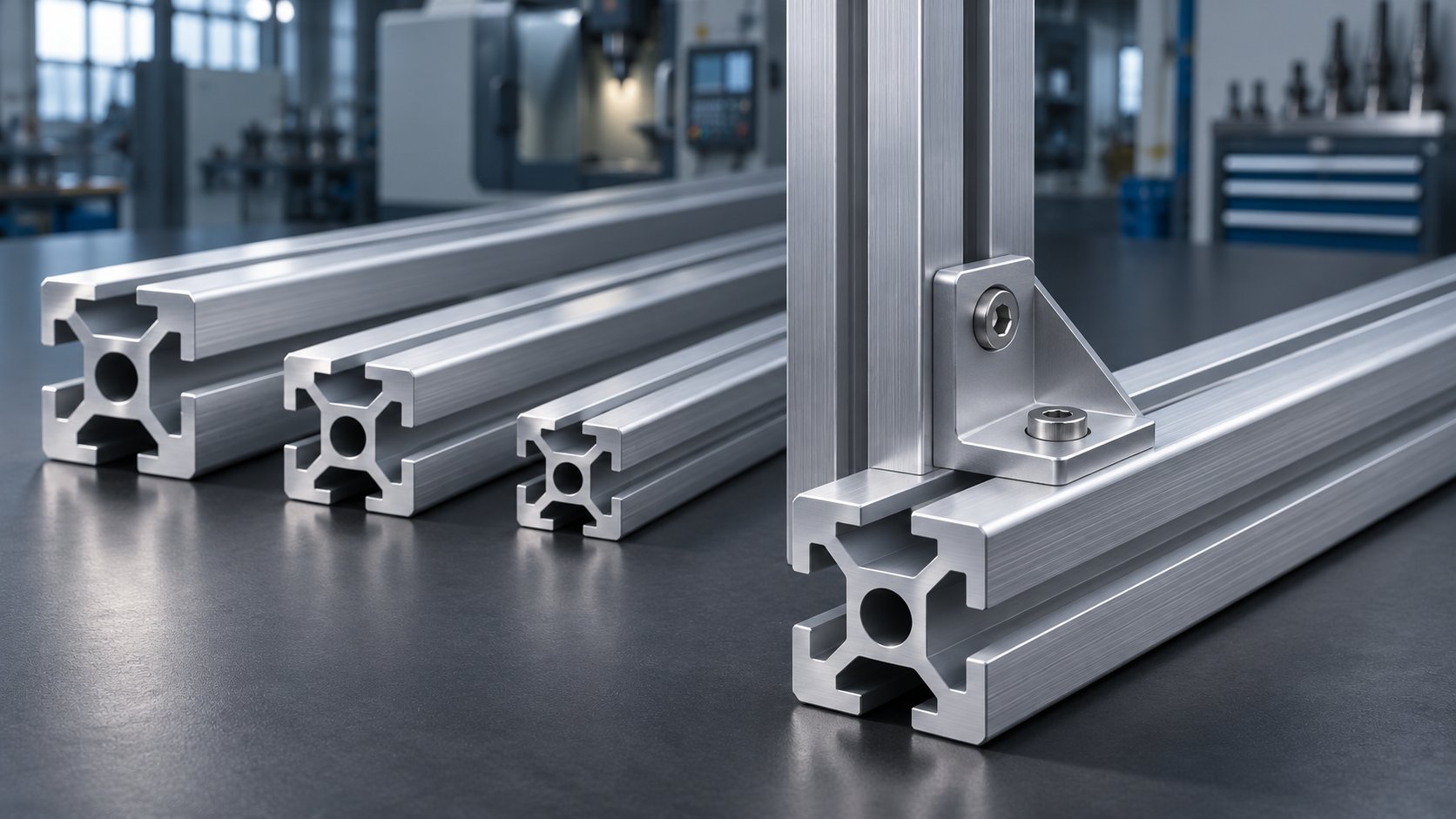
Have you ever ordered a part called "40x40" and found that the T-nuts you already owned would not slide into it? That mistake is common, and it usually starts with a fuzzy idea of what the part actually is. This section gives you a clear definition before the details begin.
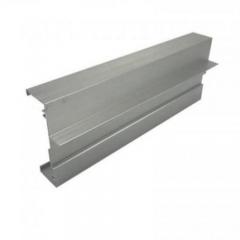
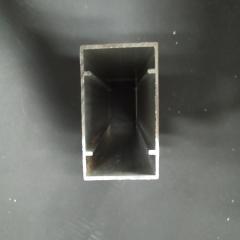
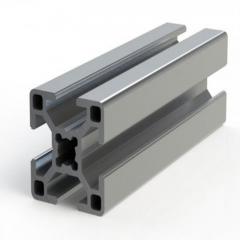
A 4040 aluminium extrusion is a square T-slot profile measuring 40 mm by 40 mm, extruded from aluminium alloy, typically with a T-shaped slot on each face, and used as a modular framing member that bolts together with T-nuts, brackets and fasteners to build frames, guards and workstations.
The name is a size code. The first two digits give the width, and the last two give the height, both in millimetres. You'll see the same part listed as 40x40, 40 40, 40/40 or 40-4040, depending on the catalog.
That last format comes from series-based naming. In the 80/20 naming guide, metric profiles carry a series prefix, such as 30-3030 for a 30 mm x 30 mm profile. The same guide gives a warning: in some fractional-inch series, a number like 1515 means 1.50 inches, and the last two digits can sometimes indicate slot count rather than height. So a number alone does not always tell you the units.
The 40 series sits in the middle of the range. Lighter 20 and 30 series profiles suit small, low-load builds. Heavier 40x80 and 80x80 sections handle long spans and big loads. The 40x40 size covers a wide band of work in between. GAP Engineering notes it is used in everything from machine guarding to warehouse racking.
The bigger draw is how you build with it. You join parts with T-nuts and brackets instead of welding. That means rapid assembly, easy reconfiguration and no fabrication shop. Need to move a shelf or extend a frame? Loosen a few bolts and slide it.
This guide covers:
Still, a 40 mm outer size tells you very little about how a profile will perform or what hardware it will accept. Those answers sit in the numbers on the supplier's datasheet.
A 4040 datasheet usually holds a cross-section drawing, a few dimensions and a short table of numbers. Many buyers check the 40 mm outline and move on, and that is often where costly mistakes begin. Each field answers a specific question about fit, stiffness or weight. Here is how to read them.
Start with the drawing, not the price. The outer dimension confirms the 40 mm square. The slot details decide whether your hardware will fit.
Ask for the dimensioned cross-section drawing or CAD file, and keep it with your design files. It is the only reliable way to check slot geometry before you buy.
Moment of inertia (Ix and Iy) measures how well the section resists bending about each axis. A higher value means less deflection. Section modulus (Wx and Wy) links bending moment to stress, so it shows how close a beam is to its strength limit.
A symmetric square 4040 normally has equal Ix and Iy, but you should still check. Watch the units too. Some sheets use mm4 and others use cm4, and 1 cm4 equals 10,000 mm4.
Real figures show why this matters. On the Misumi 40x40 datasheet, the standard HFS8-4040 weighs 1.73 kg/m with Ix = Iy = 10.4 x 104 mm4. The lightweight version weighs 1.27 kg/m with 7.54 x 104 mm4. The high-rigidity version, made from a 6061-T6 equivalent, weighs 2.17 kg/m with 13.76 x 104 mm4. All three share the same 40 mm outline, yet the stiffest is nearly double the lightest. Note also that the standard type is listed in A6N01SS-T5 rather than 6063. That is one more reason to read the alloy line instead of assuming it.
Use this template to record each supplier's values.
| Datasheet Field | Typical Symbol | Where to Find It | Why It Matters |
|---|---|---|---|
| Outer dimension | A x B | Cross-section drawing | Confirms the profile footprint |
| Slot opening width | s or b | Drawing slot detail | Decides T-nut and bolt fit |
| Slot depth | t or h | Drawing slot detail | Affects nut engagement and rotation |
| Center bore diameter | D or d | Drawing center | Sets the end-tapping thread size |
| Moment of inertia | Ix, Iy | Specification table | Drives deflection calculations |
| Section modulus | Wx, Wy | Specification table | Drives bending stress checks |
| Weight per meter | kg/m | Specification table | Affects frame mass, shipping and cost |
| Alloy and temper | e.g. 6063-T5 | Material line or certificate | Sets strength and machinability |
Weighing two quotes? Follow these steps.
As the Misumi figures show, profiles with the same 40 mm outline can perform very differently. The cause usually lies in how the section is built: open or closed faces, thin or thick walls, and how much metal the extruder put in the core.
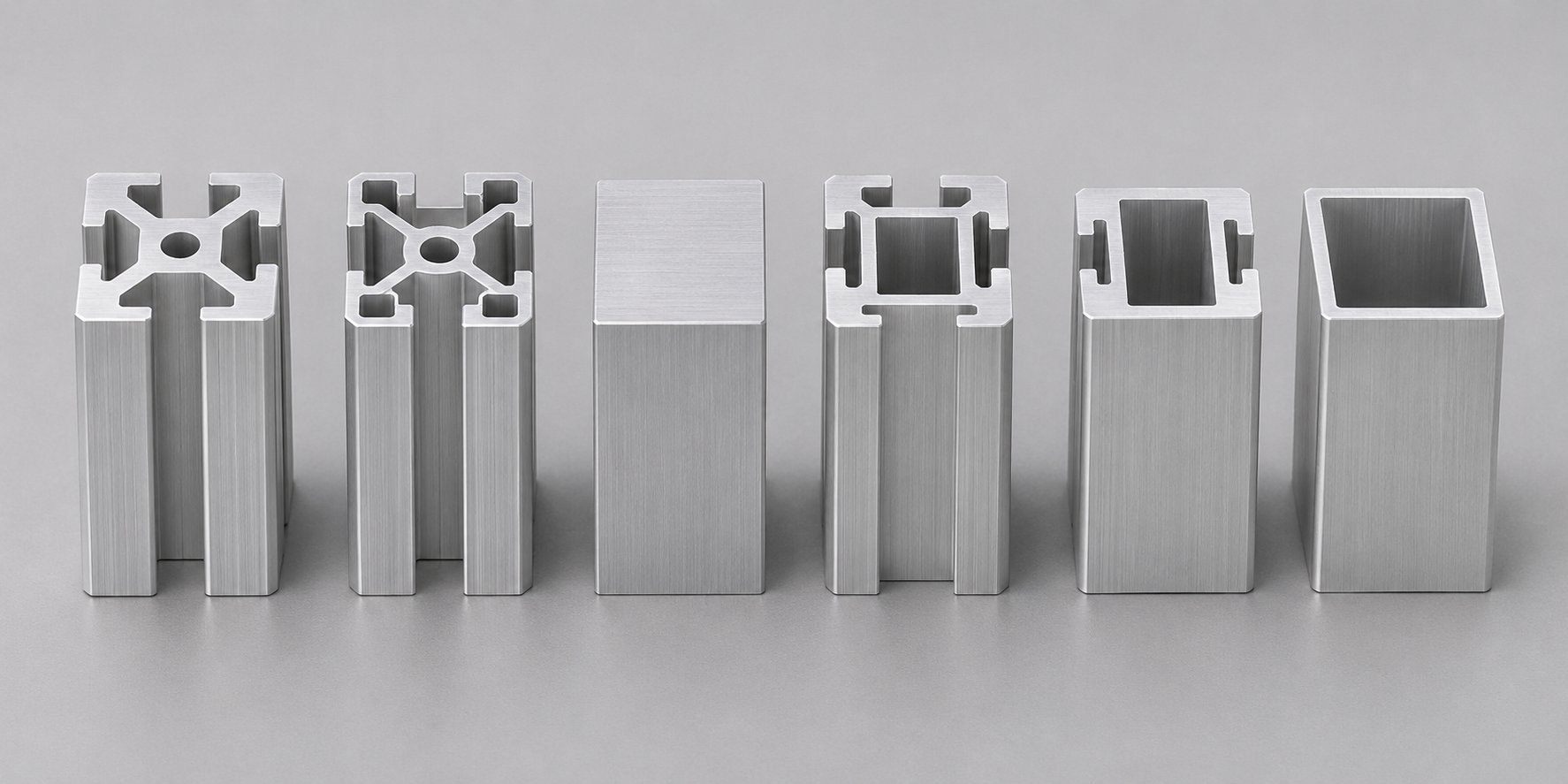
Imagine two frames built from the same 40 mm outline. One looks like a tidy cabinet. The other is covered in open grooves that collect dust and chips. The difference usually isn't the size. It's the variant. Most catalogs list several 4040 t slot profile variants, and picking the right one saves cleaning time, money and redesigns.
The default profile has an open T-slot on every face. You can mount brackets, panels, hinges or sensors anywhere along any side. That freedom is why it dominates prototypes and test rigs.
A 4040 profile with closed sides replaces one, two or three slots with a smooth, flat wall. You'll notice three benefits right away:
The trade-off is simple. Every closed side is one less place to attach an accessory. Close the wrong face, and you may end up drilling holes later. Hygienic environments follow the same logic. Cleanroom profile designs favor hidden fasteners and smooth surfaces that are easy to clean.
Wall thickness is the other big variable. As Framing Tech explains, light, regular and heavy versions differ mainly in how much aluminium sits in the cross section. Light and regular types use internal voids to save metal, and a light profile can weigh about 25% less than a comparable regular one.
More material raises both moment of inertia and weight per meter. That is why heavy 4040 extruded aluminum resists bending better while keeping the same outline. Its extra mass can also improve machine stability, and thicker walls leave more room for milling pockets or custom features.
| Variant | Aesthetics | Relative Stiffness | Accessory Mounting Flexibility | Cleaning | Typical Use |
|---|---|---|---|---|---|
| Four open slots | Grooves visible on all faces | Baseline | Highest | Harder, slots trap debris | Prototypes, jigs, changing frames |
| One closed side | One clean face | Similar or slightly higher | High | Easier on the closed face | Frame edges facing operators |
| Two closed sides | Clean outer corner | Similar or slightly higher | Moderate | Easier | Outer corners of enclosures |
| Three closed sides | Mostly smooth | Similar or slightly higher | Lowest | Easiest | Trim, panel edges, hygienic areas |
| Light wall | Same as standard | Lower | Same slot count | Same as slot layout | Doors, guarding, light covers |
| Heavy wall | Same as standard | Higher | Same slots, more material to machine | Same as slot layout | Machine frames, longer spans |
Closed-side stiffness varies by design, so always compare Ix on the datasheet rather than assuming a gain.
Variant choice still leaves one question open. Two profiles with identical drawings can behave differently if one is extruded from a different alloy or temper. The metal inside the shape deserves a closer look.
Two 4040 profiles can share the same drawing and still behave differently when you tap a thread or tighten a bracket. The reason sits in two short codes on the datasheet: the alloy and the temper. Sounds technical? They take about two minutes to decode.
Both alloys follow the Aluminum Association's four-digit system. The leading 6 marks the 6xxx series, where magnesium and silicon are the main alloying elements. The remaining digits identify the specific alloy. 6061 carries more magnesium and silicon than 6063 and adds a small amount of copper. That extra alloy content is why it ends up stronger.
The strength gap is real. Eagle Aluminum lists 6061-T6 at a minimum of 42,000 psi tensile and 35,000 psi yield strength. A published temper comparison puts 6063-T5 at 160 MPa tensile and 110 MPa yield, roughly 23,000 psi and 16,000 psi.
The letter and number after the dash describe how the metal was heat treated.
T5 makes use of heat that is already in the extrusion, so it skips a processing step. T6 adds that step to reach higher strength and hardness. That covers the core of the T5 vs T6 temper question for aluminum extrusion: same family, different thermal history.
For most T-slot framing, 6063-T5 is the default 4040 aluminum extrusion alloy. It flows through complex slot dies easily, leaves a smooth surface and anodizes cleanly. 6061-T6 earns its place when you need higher strength, heavy secondary machining, or threads that survive repeated assembly.
| Factor | 6063-T5 | 6061-T6 |
|---|---|---|
| Relative strength | Moderate | Higher |
| Extrudability | Excellent, suits intricate slot shapes | Moderate |
| Surface and anodizing quality | Smooth, uniform, anodizes cleanly | Good, but less refined |
| Machinability | Fine for cutting and end tapping | Better for heavy milling and durable threads |
| Typical cost tendency | Lower, widely stocked | Higher |
| Best-fit applications | Frames, guards, enclosures, workstations | Highly loaded joints, heavily machined parts, high-rigidity series |
So which is the best alloy for 40mm aluminum extrusion? For general framing, 6063-T5 usually wins on cost and finish. Pick 6061-T6 when threads, machining or local stresses are the real limit. And remember the Misumi example from earlier: suppliers sometimes use other 6xxx grades, so the label matters.
Never assume the alloy or temper from the profile shape or price; confirm it on the supplier's material certificate before you approve the order.
There is one thing an alloy upgrade won't buy you, though. Aluminium alloys share nearly the same elastic modulus, so a 6061-T6 beam sags almost exactly as far as a 6063-T5 beam of the same section under the same load. Misumi's high-rigidity profile gained its stiffness from extra metal in the cross section, not from the alloy alone. Strength decides when a beam yields. Geometry, span and supports decide how far it bends before then.
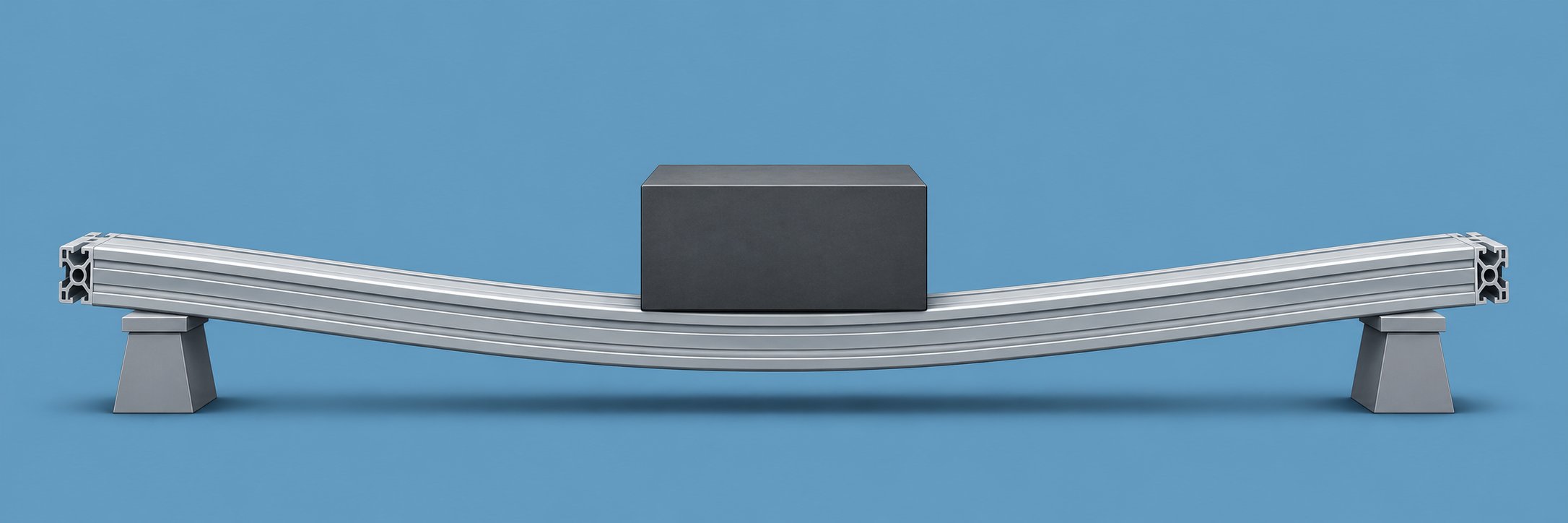
Picture a 4040 crossbar carrying a spindle, a camera or a shelf of parts. It almost never snaps. It sags. On a precision machine, even a fraction of a millimeter of sag can ruin accuracy. That's why 4040 aluminum extrusion load capacity is usually limited by deflection long before strength. The good news? You can estimate it with a few textbook formulas and the Ix value from your datasheet.
How a beam is held matters as much as the profile itself. Profile makers such as mk build their deflection calculators around the same three load cases:
The variables are simple. E is the elastic modulus of aluminium. I is the moment of inertia from the datasheet, using Ix or Iy for the axis you are bending about. L is the span. F is a point load, and w is a load per unit length. The maximum deflection formulas below come from standard beam deflection tables.
| Support Case | Point Load F (center, or free end for cantilever) | Uniformly Distributed Load w | Maximum Bending Moment |
|---|---|---|---|
| Simply supported | F x L3 / (48 x E x I) | 5 x w x L4 / (384 x E x I) | FL/4 or wL2/8 |
| Fixed at both ends | F x L3 / (192 x E x I) | w x L4 / (384 x E x I) | FL/8 or wL2/12 |
| Cantilever | F x L3 / (3 x E x I) | w x L4 / (8 x E x I) | FL or wL2/2 |
You'll notice two things right away. First, length dominates everything. Point-load deflection grows with the cube of the span, and distributed-load deflection grows with the fourth power. Double a span from 500 mm to 1000 mm, and deflection rises 8 times under a point load and 16 times under a distributed load. Second, supports change the picture dramatically. The same point load on a cantilever deflects 16 times more than on a simply supported beam of equal length, and 64 times more than on a fixed-fixed beam.
The moment column handles strength. Divide the maximum moment by the section modulus W from your datasheet to get bending stress, then compare it with the yield strength of your alloy.
Absolute values depend on your supplier's I and the elastic modulus they publish, so this 4040 beam span table shows relative point-load deflection. A simply supported 500 mm beam is the 1x baseline. Calculate that baseline once with your own numbers, then multiply.
| Support Case | 500 mm | 1000 mm | 1500 mm |
|---|---|---|---|
| Simply supported | 1x | 8x | 27x |
| Fixed at both ends | 0.25x | 2x | 6.75x |
| Cantilever | 16x | 128x | 432x |
| Allowable deflection at L/500 | 1.0 mm | 2.0 mm | 3.0 mm |
Look at the last row. The allowable limit grows only in step with length, while deflection grows with its cube. Going from 500 mm to 1500 mm makes the limit 3 times larger but the deflection 27 times larger. A profile that passes easily at 500 mm can fail badly at 1500 mm.
Use this checklist for every 4040 extrusion deflection calculation:
Real T-slot joints sit somewhere between pinned and fully fixed, so treat the fixed-end figures as a best case and the simply supported figures as your design case.
That joint behavior is the hidden variable. A bracket only delivers its rated stiffness when its T-nuts seat fully in the slot, and a nut that almost fits can let a carefully calculated beam flex far more than the math predicts.
That T-nut that almost fits is rarely bad luck. It usually means the profile and the hardware come from different slot systems. Say you buy a generic 40x40 profile and plan to use brackets from item, Bosch Rexroth, Misumi or 80/20. The 40 mm outer size tells you almost nothing about whether those parts will fit.
Four parameters decide 4040 t slot fastener compatibility:
Start with units. 80/20 sells both fractional-inch and metric series. Its naming guide explains how to tell them apart. Metric parts carry a series prefix, as in 40-4040, while inch parts usually do not. Why does that matter? The fractional 15 series measures 1.5 inches, or about 38.1 mm. It looks close to a 40 mm profile, but its slots and fasteners belong to a different system. So always check 80/20 40-4040 compatibility against the metric part's drawing, never against the inch catalog.
Many European-style 40 series systems use an 8 mm slot, so the 40 series 8mm slot profile is a common pairing. It is not universal, though. Alu-Verkauf points out that a 40 x 40 profile can be designed with groove 8 or groove 10. That can happen even within one manufacturer's range. Labels such as "groove 8" describe each brand's own system logic, not a shared standard. A Misumi 4040 aluminum extrusion, an item profile and a Bosch Rexroth profile may all read "40 x 40." They can still differ in undercut, slot depth and core bore.
| Brand or System | Slot Type to Verify | Fastener Family | Compatibility Notes |
|---|---|---|---|
| 80/20 metric 40 series (40-4040) | Metric slot geometry on the 40-4040 drawing | 80/20 metric 40 series hardware | Do not mix with fractional 15 series parts, despite the similar size. |
| 80/20 fractional 15 series | Inch-based slot | 15 series hardware | About 38.1 mm wide, so it is not a 40 mm metric profile. |
| Misumi 40 series | Slot series called out in the part number, such as HFS8 | Misumi series-specific nuts and brackets | Match the slot series in the part number, not just the 4040 size. |
| item 40 series | Groove size for each product line | item system fasteners | The same 40 x 40 size may exist in more than one groove series. |
| Bosch Rexroth 40 series | Groove 8 or groove 10, by series | Bosch Rexroth system fasteners | Not compatible with item components across the whole system. |
| Generic 40x40 | Opening, undercut, depth and bore | Often sold as "8 mm" or "10 mm" T-nuts | A nominal slot size alone does not prove fit. Check it against the drawing. |
Planning to mix brands? Run through this list before any bulk order:
Getting the slot right means every bracket seats properly. It does not prove that 40 mm was the right size in the first place. Some frames need far less metal than a 4040 carries, and others need much more.
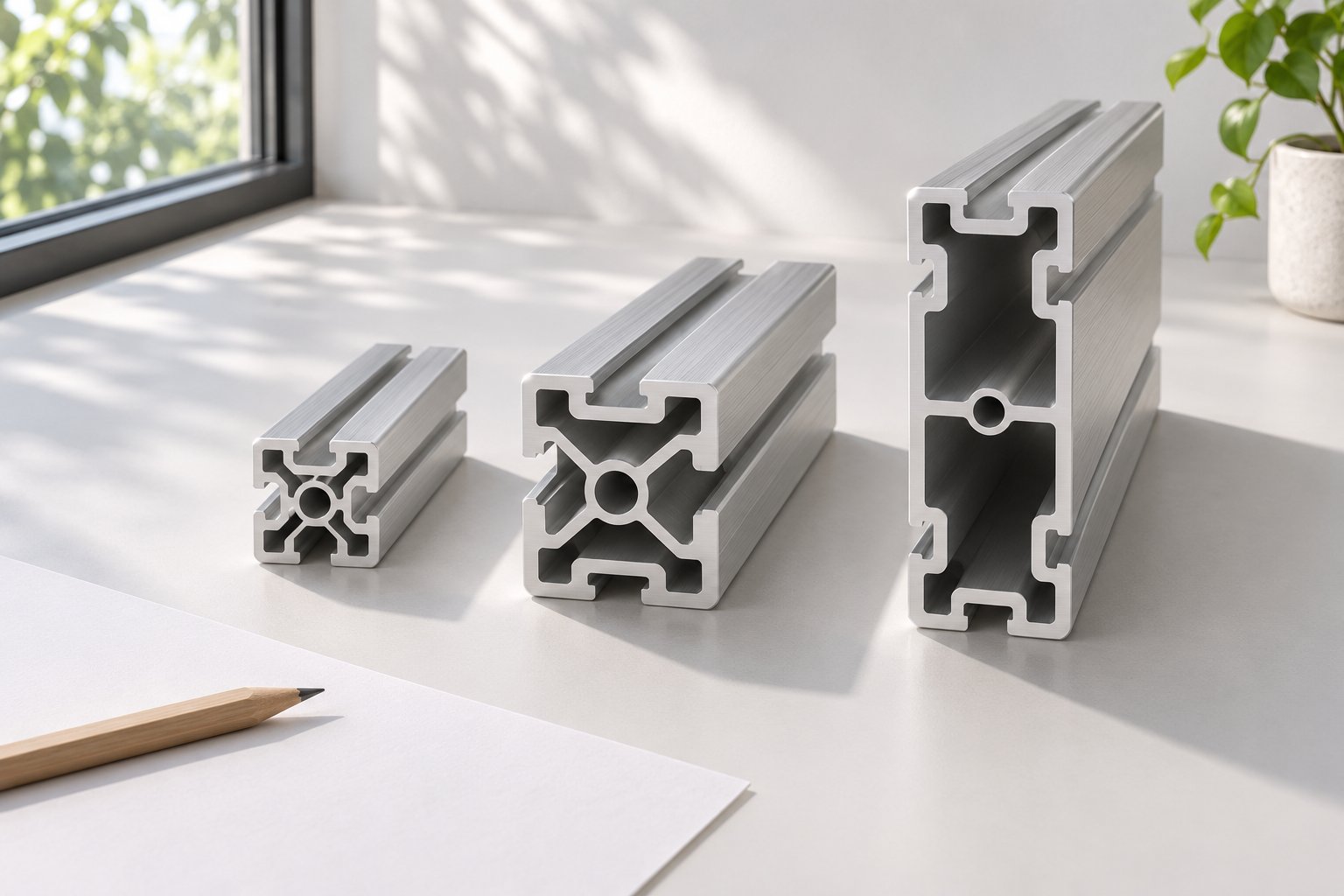
Is a bigger profile always the safer pick? Not with aluminium framing. An oversized section adds weight, cost and bulk without improving the build. An undersized one sags. Choosing aluminum extrusion size means matching the section to the real load case, and sometimes 4040 simply is not the answer.
The 3030 vs 4040 aluminum extrusion question comes down to load and span. Bor USA makes a useful point here: a profile that only supports a lightweight enclosure should not be designed like a primary machine beam. A 3030 or smaller profile often works well for:
Keep the stiffness gap in mind, though. For solid squares, moment of inertia scales with the fourth power of side length, so a 40 mm square is roughly three times stiffer than a 30 mm one. Run the deflection check from the previous section with your supplier's 3030 values. If it passes with a comfortable margin, the smaller profile saves material, weight and space.
Standard 4040 starts to struggle when you see these triggers:
Heavy 4040 is the first step when the 40 mm footprint must stay. A 4080 aluminum extrusion is the next. Always compare datasheet values rather than outlines. In Vention's benchmarks, five profiles with the same 45x45 mm outline varied by 50% in moment of inertia.
40x80 aluminum extrusion orientation changes everything. Stand it with the 80 mm side vertical against a downward load, and it resists bending far better than when laid flat. For a solid rectangle, I = b x h3 / 12, so turning the section on edge makes it about four times stiffer in that axis. Vention notes the same effect on 45x90 profiles. Real T-slot sections vary, so confirm with the Ix and Iy values on the datasheet.
| Situation | Recommended Profile | Reason |
|---|---|---|
| Light covers, desktop fixtures, short lightly loaded spans | 3030 | Adequate stiffness with less weight and cost |
| General frames, benches and guards with moderate spans | Standard 4040 | Balanced stiffness and a wide accessory range |
| Longer spans that must keep a 40 mm footprint | Heavy 4040 | Higher I without changing the outline |
| Gantry beams, long spans, cantilevered arms | 4080, tall side vertical | Much higher stiffness in the main load axis |
| Heavy machine bases, columns, loads in two directions | 8080 | High stiffness about both axes |
Why does stiffness lead? Aluminium alloys share an elastic modulus of about 69 GPa, so rigidity comes from geometry, not alloy. Strength still matters, and Vention suggests a safety factor of 4 to 5 for extrusion structures.
Size by stiffness first, then strength: pick the profile that meets your deflection limit, then confirm stress and safety factor.
A correctly sized profile is only part of a good frame, though. A 3D printer, a safety guard and an assembly bench can all use the same 4040 section, yet each one calls for a different variant and a different way of joining the pieces.
When you sketch a new frame, two questions decide most of the details: which 4040 variant goes where, and how the joints will connect. The range of builds is wide. Parco lists machine safety guarding, workstations, desk modules, climate control enclosures, material handling racks and laser enclosures among the common uses of T-slot framing. Each one asks something different of the profile.
A 4040 extrusion CNC frame lives or dies on rigidity. Cutting forces and vibration expose every weak joint, so heavy 4040 or a 4080 gantry beam is common where the deflection check calls for it. Gussets at the corners help resist racking.
A 4040 aluminum extrusion 3D printer frame carries lighter loads, so a standard profile with four open slots usually works. The open slots give you places to mount rails, motors and wiring. Squareness matters more than raw strength here. A frame that is slightly out of square shows up directly in print quality.
A 40mm aluminum extrusion workstation benefits from adjustability. Shelf heights, monitor arms and tool rails often move as tasks change. Guards and enclosures put the focus on panels. Light or standard profiles hold infill panels well, and closed-side profiles keep exposed edges clean and easy to wipe down.
| Application | Recommended 4040 Variant | Typical Connectors | Key Consideration |
|---|---|---|---|
| 3D printer frames | Standard, four open slots | Corner brackets, end-tapped connections | Squareness and mounting points for rails and motors |
| CNC machine frames | Heavy 4040, or 4080 for gantries | Gussets, internal anchor fasteners | Stiffness and vibration, so run the deflection check |
| Workstations and assembly benches | Standard, closed side facing the operator | Corner brackets, gussets, end-tapped legs | Adjustable shelf and accessory heights |
| Machine guards and safety fencing | Light or standard | Panel retainers, corner brackets | Secure infill panels and door hinge loads |
| Enclosures | Closed-side profiles on exposed edges | Hidden internal connectors, panel retainers | Clean appearance and easy cleaning |
| Display stands | One or two closed sides | Hidden internal connectors, end-tapped connections | Visible joints and finish quality |
| Jigs and fixtures | Four open slots | Corner brackets, T-nuts | Frequent reconfiguration |
Connectors fall into two broad camps, as 80/20's fastener guide explains:
Use external brackets where the frame will change, and internal connectors where the frame must look clean or stay flush.
That choice has a hidden cost, though. Internal connectors often depend on tapped bores and drilled access holes, and every bracket depends on slots that still fit after the profile has been finished. The surface treatment and the machining you specify end up shaping how well these joints assemble.
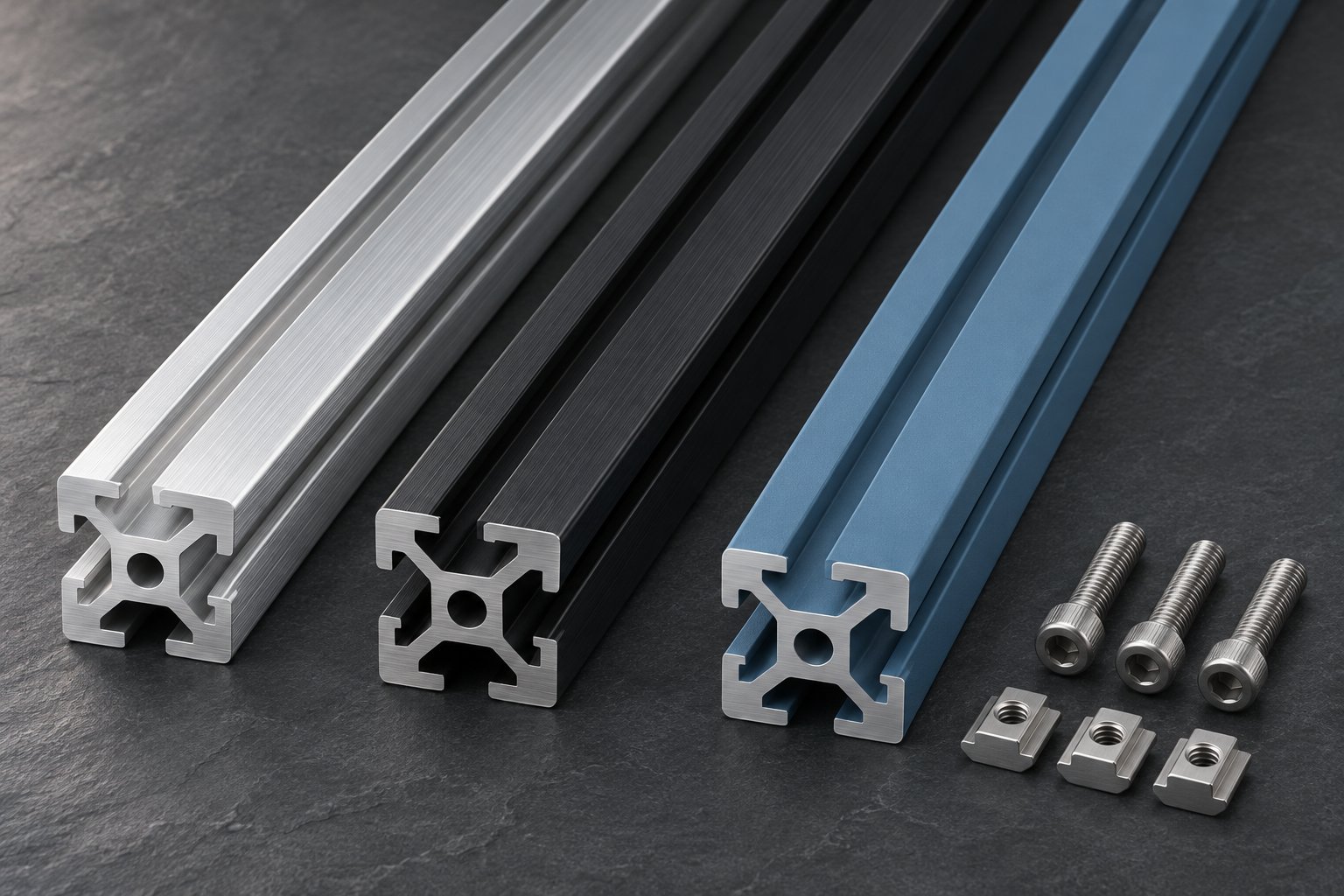
When you pick a finish from a color chart, you are also deciding how your T-nuts will slide, how scratches will look and how the frame will age. Machining choices work the same way. Together they decide whether assembly takes an afternoon or a week.
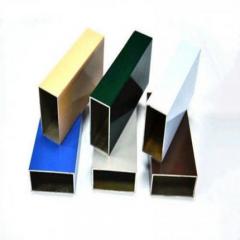
Anodizing converts the aluminium surface itself into aluminium oxide. As Linkedalu's finishing guide explains, the layer grows out of the metal, so it cannot flake or peel the way a coating can. It is also thin. The common architectural grades are AA15, nominally 15 microns for interior use, and AA20, nominally 20 microns for exterior use. Clear anodizing keeps the metallic look. A black anodized 4040 aluminum extrusion suits machines and displays that need a dark, low-glare frame. Darker colored anodizing also hides handling marks better than clear, although dark shades can show lot-to-lot color variation more clearly.
Powder coating sprays a polymer powder onto the profile and cures it into a continuous film, typically 60 to 80 microns for architectural work. It can match almost any RAL color and tolerates handling damage well. For T-slot framing, that thickness is the catch. The film also builds up inside the slot, so T-nuts may bind. Ask whether the slots will be masked, or test-fit a coated sample first.
Mill finish is the bare extrusion straight off the press. It shows extrusion lines and handling marks and has only a thin natural oxide layer. That makes it fine for concealed members or parts you will paint later, but a poor choice for exposed frames.
| Finish | Corrosion Protection | Appearance | Effect on Slot Fit | Typical Use |
|---|---|---|---|---|
| Clear anodizing | Good, integral layer | Metallic silver | Minimal, thin layer | Workstations, guards, general frames |
| Black anodizing | Good, integral layer | Dark, low glare | Minimal, thin layer | Machines, optics, display stands |
| Powder coating | Good if pretreatment is sound | Any RAL color, opaque | Thicker film can tighten slots | Color-matched enclosures and equipment |
| Mill finish | Minimal | Raw, visible die lines | None | Hidden members, parts finished later |
Fabrication matters here too. Every cut or drilled hole in a powder-coated profile leaves bare metal, which Linkedalu notes needs touching up.
Most frames need a few operations beyond the raw profile:
Imagine cutting and tapping 80 legs in your own shop. You would need saw setups, deburring, chip cleanup and the occasional broken tap. Ordering 4040 aluminum extrusion cut to length, with the machining already done, means parts arrive ready to bolt together. Paramount also notes that on production runs, working with the supplier on machining cuts downstream labor and tooling costs.
Many manufacturers offer this service. Shengxin Aluminium's 40x40 T-slot aluminium profile with custom finishing is one example, with customized lengths, surface finishes and secondary machining listed. Whichever supplier you use, confirm the finish specification and every machining detail in writing before production.
Each of these choices adds a line to your order: a finish, a tap size, a list of lengths. A quote only comes back accurate when all of those lines, plus the profile, slot and alloy decisions made earlier, are written down in one place.
Have you ever sent a quote request that said only "40x40 profile, 200 pieces"? The quotes that come back can't be compared, because each supplier filled the gaps with its own assumptions. One supplier priced a light profile with a mill finish. Another priced a heavy profile with black anodizing. A complete specification removes that guesswork and turns the earlier sections of this guide into one clear document.
Define these eight items before you ask for a price:
An extrusion RFQ guide from Aluminum Ave also lists packaging, certifications and lead time. Adding those items makes quotes easier to compare side by side.
If you plan to buy 40x40 aluminum extrusion in bulk, going direct to a 4040 aluminum extrusion manufacturer often pays off. The company that runs the die also handles cutting, finishing and machining, so one specification covers the whole chain and pricing reflects your volume. The catch is the minimum order quantity, which is often set by weight. These are the common routes:
Whichever OEM 4040 T-slot profile supplier you choose, request the dimensioned drawing first, then order a sample length. Test-fit your T-nuts and brackets, check how the finish sits inside the slots, and inspect the cut and tapped ends. Approve production only after the sample passes every check. A few days spent on a sample costs far less than a pallet of profiles that won't accept your hardware.
Size your 4040 profile by stiffness first, prove slot compatibility with a real sample, and put every decision in writing before you commit to a bulk order.
A 4040 profile has a 40 mm x 40 mm square outline, usually with a T-slot on each face and a center bore that can be tapped for end connections. The outline is the only dimension that is truly fixed. Slot opening (often 8 mm on 40 series systems), slot depth, undercut shape, bore size and wall thickness all vary by supplier. Weight and stiffness vary too. Misumi's 40x40 range, for example, spans a lightweight type at 1.27 kg/m to a high-rigidity type at 2.17 kg/m, all with the same 40 mm outline. Always work from the supplier's dimensioned cross-section drawing rather than the name alone.
Not necessarily. Two profiles can both be sold as 40x40 and still use different slot systems. Fit depends on the slot opening width, the undercut shape, the slot depth and the center bore, not the outer size. Some 40 x 40 profiles are made with groove 8 and others with groove 10, sometimes within the same brand. Also watch for inch-based systems such as the 80/20 fractional 15 series, which is about 38.1 mm wide and uses different hardware from the metric 40-4040. The safest approach is to compare the profile drawing with the hardware maker's drawing, then test-fit nuts and brackets on a short sample before placing a bulk order.
There is no single load rating, because capacity depends on span, support condition and how much sag your application can accept. In most frames, deflection limits the design long before the aluminium yields. To estimate it, take the moment of inertia (Ix or Iy) from the datasheet and apply the standard beam formula for your case: simply supported, fixed at both ends, or cantilever. Span has a huge effect: point-load deflection grows with the cube of length, so tripling a span makes it 27 times larger. Compare the result with an allowable limit such as L/500 for precision machines, check bending stress against yield, and keep a generous safety factor. Treat bolted joints as closer to simply supported than fully fixed.
For most T-slot frames, guards, enclosures and workstations, 6063-T5 is the practical default. It extrudes intricate slot shapes cleanly, gives a smooth surface, anodizes well and usually costs less. Choose 6061-T6 when threads must survive repeated assembly, when parts need heavy milling, or when joints carry high local stress, since its tensile and yield strength are significantly higher. Keep in mind that both alloys have nearly the same elastic modulus, so switching alloys will not reduce sag. To make a beam stiffer, add metal to the section, shorten the span or move to a larger profile such as heavy 4040 or 4080. Confirm the actual alloy and temper on the supplier's material certificate.
Yes. Many manufacturers supply 4040 profiles cut to length, anodized or powder coated, and machined with end taps, counterbores or anchor fastener holes, so parts arrive ready to bolt together. For example, Shengxin Aluminium lists a 40 x 40 mm T-slot profile in 6063-T5 or 6061-T6 with customized lengths, surface finishes and secondary machining, aimed at industrial and OEM buyers. Its 500 kg minimum order quantity suits volume programs more than one-off hobby builds. Before production, send a full specification covering variant, slot system, alloy, cut list with tolerances, finish and machining drawings, then confirm slot dimensions and connection details on a sample. If you choose powder coating, ask whether slots will be masked so T-nuts do not bind.



 Інтернет-сервіс
 0086 136 3563 2360
 sales@sxalu.com
 +86 136 3563 2360
 Українська
 English
 français
 Deutsch
 русский
 español
 português
 العربية
 ไทย
 Việt