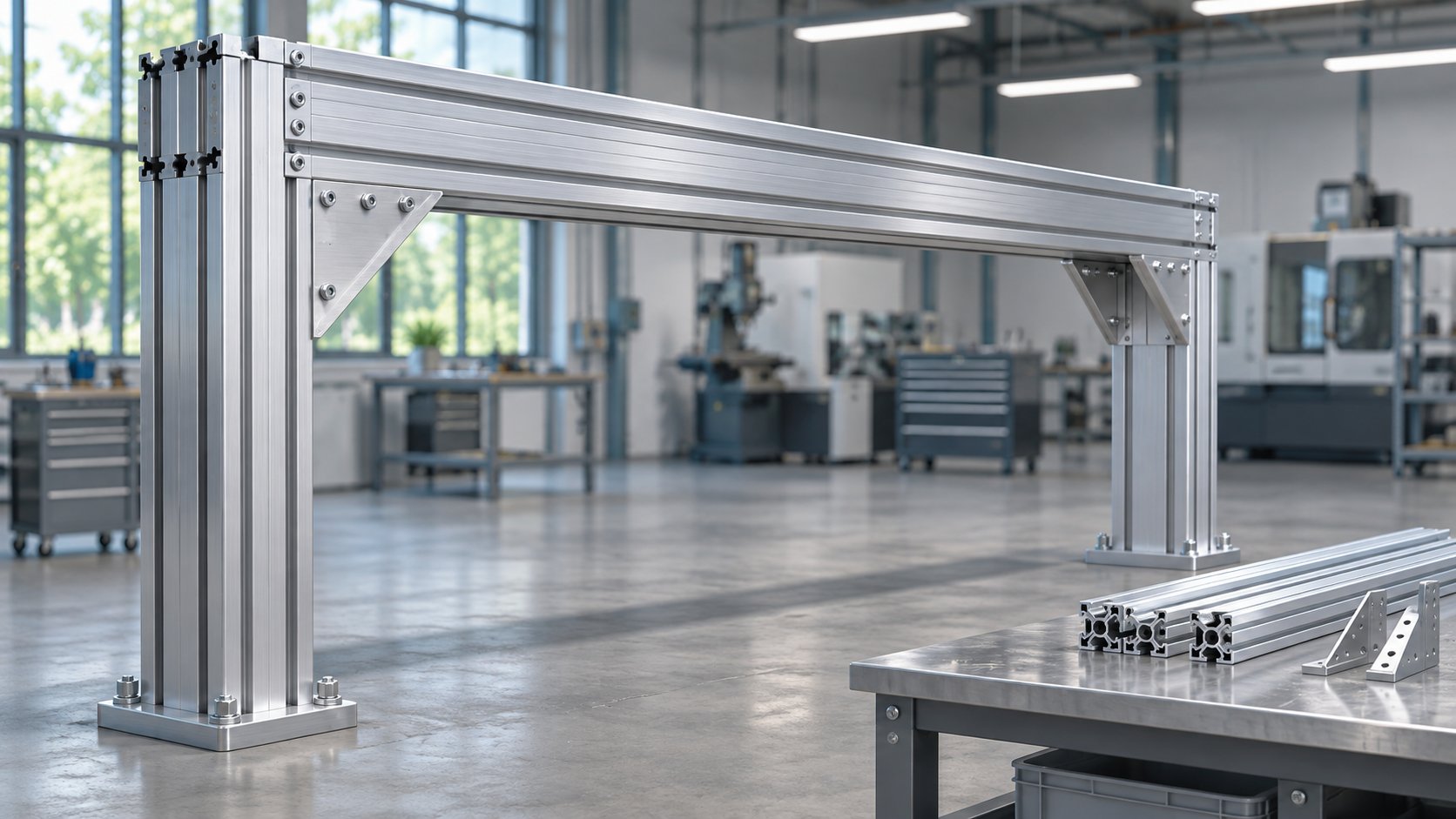
Need a frame that won't flex the moment you load it? Many product listings call their profiles "heavy duty," but the top-ranking pages for this term are mostly shopping category pages. They use the label without defining it. This guide stays vendor-neutral, so you can judge any profile on its actual merits.
A heavy duty aluminum extrusion is a profile engineered to carry higher loads, resist deflection, or withstand impact better than light framing sections. It is not a standardized industry grade. The term describes a combination of alloy, temper, wall thickness, profile size, and cross-sectional geometry.
In other words, "heavy duty" describes a design result. It is not a certification. A slim aluminum t track screwed into a workbench and a thick-wall beam under a machine base are both extrusions, but only the beam is built for serious structural work.
Imagine pressing clay through a shaped opening. Extrusion works the same way, at industrial scale. A solid aluminum billet is preheated to roughly 700-930°F (370-500°C), loaded into a press container, and pushed through a steel die by a hydraulic ram. The die specialists at Gemini Group put typical ram pressures at 1,000 to 15,000 tons. The metal exits in the exact shape of the die opening. It is then cooled and moved on to stretching, machining, or surface finishing.
Every inch of the profile passes through the same die. That gives you long members with the same cross-section from end to end, which makes extrusions predictable as structural parts. Fabricators can cut, drill, and deburr them, then join them with socket head cap screws (SHCS) and matching hardware.
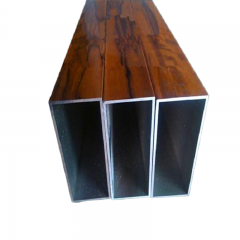
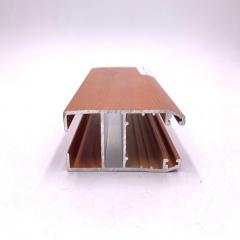
Large, thick-wall sections are common in machine frames, automation cells, industrial workstations, transport cases, and gantries. Lighter profiles handle smaller jobs, such as a vesa monitor mount arm or the edge framing that holds aluminium composite material panels in signage and enclosures. The difference between the two classes shows up once load, span, and stiffness start to matter.
To decide whether a profile truly deserves the label, this guide evaluates five criteria:
A harder alloy and a thicker wall don't improve the same property. Strength and stiffness respond to different factors, and that difference affects every choice you make about a profile.
Product pages often sum it up in one line: harder aluminum, thicker profile, more robust. That sounds reasonable, but it lumps two different properties together. Strength is a profile's resistance to yielding (bending permanently) and to breaking. Stiffness is its resistance to deflecting under load in the first place. A frame can be strong enough to never fail and still sag enough to throw a machine out of alignment.
Alloy and temper mostly control strength. The Aluminum Association maintains the alloy and temper designation system published as ANSI H35.1. The first digit of a four-digit wrought alloy number identifies its main alloying family. The 6xxx series uses magnesium and silicon. It is heat treatable, weldable, and corrosion resistant, and the association calls 6xxx extrusions the first choice for architectural and structural applications. Alloy 6061 is the most widely used member of the series.
The temper suffix tells you how the metal was processed. T6 means the alloy was solution heat-treated and then artificially aged to reach its higher strength. In a side-by-side comparison, Metal Supermarkets notes that 6061-T6 has higher yield and fatigue strength than 6063-T6, with a typical Brinell hardness of 95 versus 73. Alloy 6063 gives up some strength in exchange for a smoother finish, easier anodizing, and better corrosion resistance.
Wall thickness puts more material where loads concentrate. Thicker walls resist local crushing at clamps. They also hold tapped threads better and survive repeated tightening with a hex key wrench without stripping. The tradeoff is weight per foot. That datasheet figure is a quick proxy for how much metal is in the section, and it affects handling, shipping, and the load your supports must carry. A light vesa mount arm never needs that mass. A long frame carrying machine guarding or metal mesh panels often does.
Here's the surprise: switching from 6063 to 6061 barely changes stiffness. As MetalForming Magazine explains, all aluminum alloys share roughly the same elastic modulus, about one-third that of steel. Stiffness depends on modulus, thickness, and geometry, while hardness and temper have little effect. For a flat plate, stiffness scales with the cube of thickness, and changing an open C-channel to a closed section raises stiffness further.
For extrusions, this means the location of the material matters most. Metal placed far from the bending axis does the most work. Take a 1.5x3 rectangular profile. Stood on edge with the 3-inch face vertical, it resists bending far better than the same bar laid flat, with exactly the same metal. A datasheet might list a square tube as 3.00x3.00 in, but the moment of inertia values printed beside those dimensions tell you how it will actually perform.
| Factor | Mainly Affects | What to Check on a Datasheet |
|---|---|---|
| Alloy | Strength, corrosion resistance, surface finish | Alloy designation (such as 6061 or 6063) and its series |
| Temper | Yield and tensile strength, machinability | Temper suffix such as T6, plus published mechanical properties |
| Wall thickness | Local strength, thread holding, weight | Nominal wall dimension, tolerance, weight per foot |
| Profile size | Overall bending capacity, hardware compatibility | Outer dimensions, series, slot size |
| Cross-section shape | Stiffness and torsional resistance | Moment of inertia (Ix, Iy), section modulus, open or closed section |
Section properties only tell part of the story, though. A profile with an impressive moment of inertia can still sag badly if it spans too far between supports. Span length is where most undersized frames start to fail.
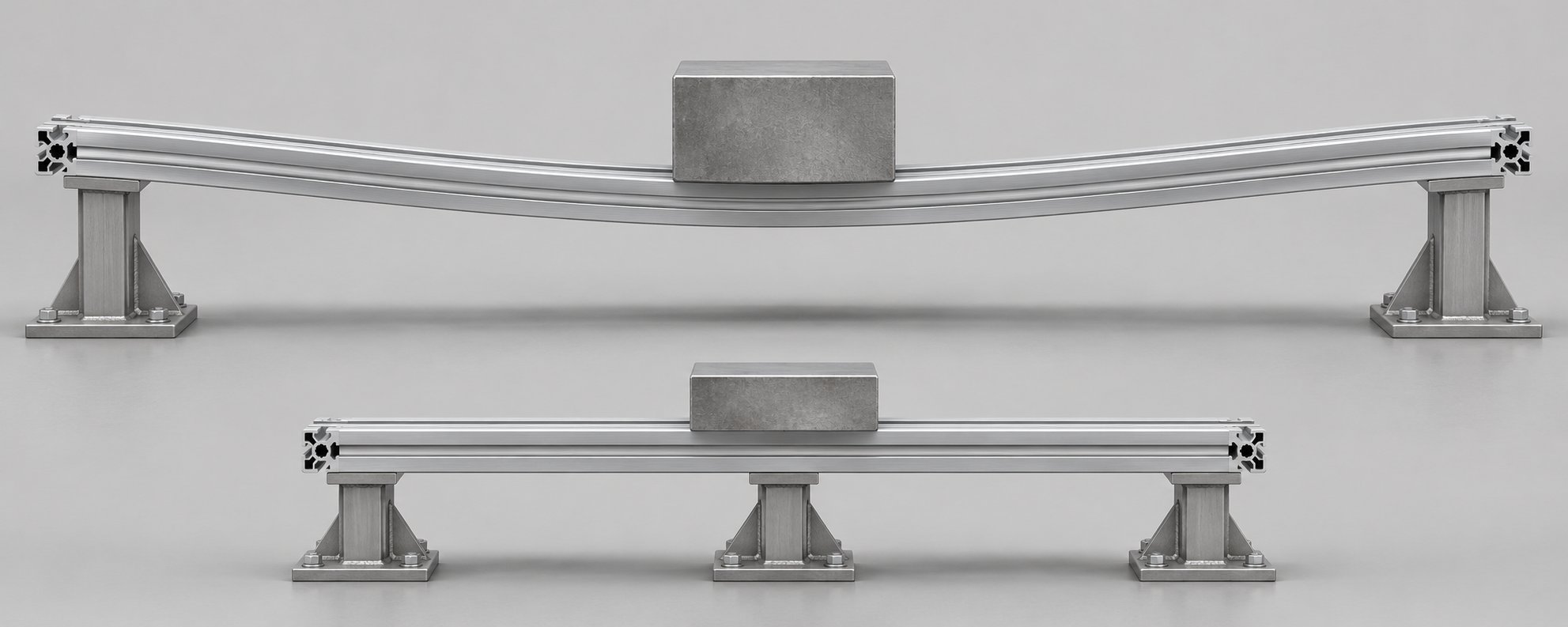
Ever loaded a shelf and watched the middle dip? That sag is deflection, and it's the detail most product pages skip. A load rating means little until you know how the profile is supported, how far it spans, and what kind of load it carries.
Moment of inertia (I) measures how well a cross-section's shape resists bending. The higher the value, the less the profile deflects under the same load. Section modulus builds on it and links the shape to bending stress, which tells you how close the metal is to yielding. Both values come from geometry, not from the alloy name.
Outer dimensions alone can mislead you. Vention's design guide compares several 45 x 45 mm T-slot profiles and lists area moments of inertia ranging from about 107,780 to 162,325 mm4. They share the same envelope but have very different rigidity. Always compare the published Ix and Iy values, not just the size in the part name.
The SkyCiv deflection tutorial names four main variables: the load, the unsupported length, the material's Young's modulus, and the moment of inertia. Span is the one that punishes you fastest. In standard beam formulas, deflection under a center point load grows with the cube of the span. Under a uniform load, it grows with the fourth power. Double the gap between supports and the sag can rise roughly eight to sixteen times.
Real test data shows the effect. A selection guide from Motion reports that a 1 x 1 inch 80/20 1010 bar bends 1/10 inch with 46 lbs centered on a 36-inch span supported at both ends. A longer bar reaches that limit at a lower weight. That's why experienced builders add cross braces and extra legs instead of relying on one long member.
The type of load matters just as much:
Plan for the worst case, too. A cart built for a 50 lb instrument may someday hold a person changing a light bulb. Use the manufacturer's published section properties, deflection charts, or calculators for your exact profile. For anything that supports people, overhead loads, or moving machinery, involve a qualified engineer.
Fill in this table with your own project values before you shortlist any aluminum extrusion.
| Item | What to Record | Your Project Value |
|---|---|---|
| Load type | Point or distributed, static or dynamic | |
| Load magnitude | Maximum expected load, including worst-case use | |
| Unsupported span | Longest distance between supports | |
| Support conditions | Cantilevered, supported at both ends, fixed to posts or a base plate | |
| Allowable deflection | Limit as a fixed distance or a fraction of span (L/X) | |
| Profile candidate | Series, size, alloy, and temper under review | |
| Manufacturer section data | Ix, Iy, section modulus, weight per foot, deflection chart source | |
| Engineering sign-off | Reviewer name, date, and safety factor applied |
Published allowable loads depend on connection design and support conditions, not just the profile.
Joints are often the weak link. Motion notes that some lighter fastening methods hold only 200 to 400 lbs, so a strong bar on flimsy brackets fails at the connection first. An aluminum plate gusset or end fasteners can bring a joint closer to the strength of the bar itself.
A completed worksheet usually forces a choice. You can step up to a bigger, heavier section, or keep a standard profile and shorten its spans. Each path has its own costs in weight, money, and fabrication effort.
Is bigger always better? Not really. A heavier section cures sag, but it also adds weight, cost, and handling effort you may not need. The goal is the lightest profile that still meets your load and deflection targets.
Most of the difference comes down to how much aluminum sits in the cross-section. Light and regular T-slot profiles usually include internal voids to save material, as Framing Tech explains. Its guide notes that a light profile can weigh roughly 25% less than a comparable regular one. Heavy sections fill in more of that space. The result is more strength, more rigidity, and more mass, and that extra mass helps steady a machine frame.
Undersize a member, though, and the problems show up quickly. It deflects, vibrates, and works its joints loose. Soon you're back with a hex wrench, tightening the same fasteners over and over.
Heavier sections cost more per foot and take longer to saw, drill, and tap. In return, the thicker material leaves room to mill pockets and slots directly into the profile. Before you upsize a whole frame, though, try local reinforcement. A flat aluminum plate or gusset at a highly loaded joint often adds the capacity you need with far less added weight. Placement matters too. In Vention's testing, moving a gusset from the top of a joint to the bottom raised moment capacity by 13%.
| Criterion | Standard or Light Duty | Heavy Duty |
|---|---|---|
| Strength | Adequate for light, self-supporting frames | Higher, suited to large or concentrated loads |
| Stiffness | Lower, more deflection over long spans | Higher, less sag and vibration |
| Weight | Lower, easier to carry and install | Higher, adds handling and support demands |
| Cost drivers | Less material per foot | More material, heavier shipping |
| Machining effort | Faster cutting and drilling | Slower, but more room for custom features |
| Typical use cases | Doors, panels, guarding, light fixtures | Machine frames, gantries, robot bases |
Many parts of a build carry very little load. In a robot cell guard example from The Knotts Company, the frame uses a light 15 series 8020 aluminum extrusion and the doors use an ultra-light version. Both stay in the same series so the hardware matches. A lighter door also opens more easily and puts less strain on its hinges and safety interlock switches.
Signals that your project needs heavy duty sections:
Those last signals point to a catch. A frame that gets bounced around in transit and a frame that carries a robot both need to be tough, but the profiles built for each job look nothing alike.
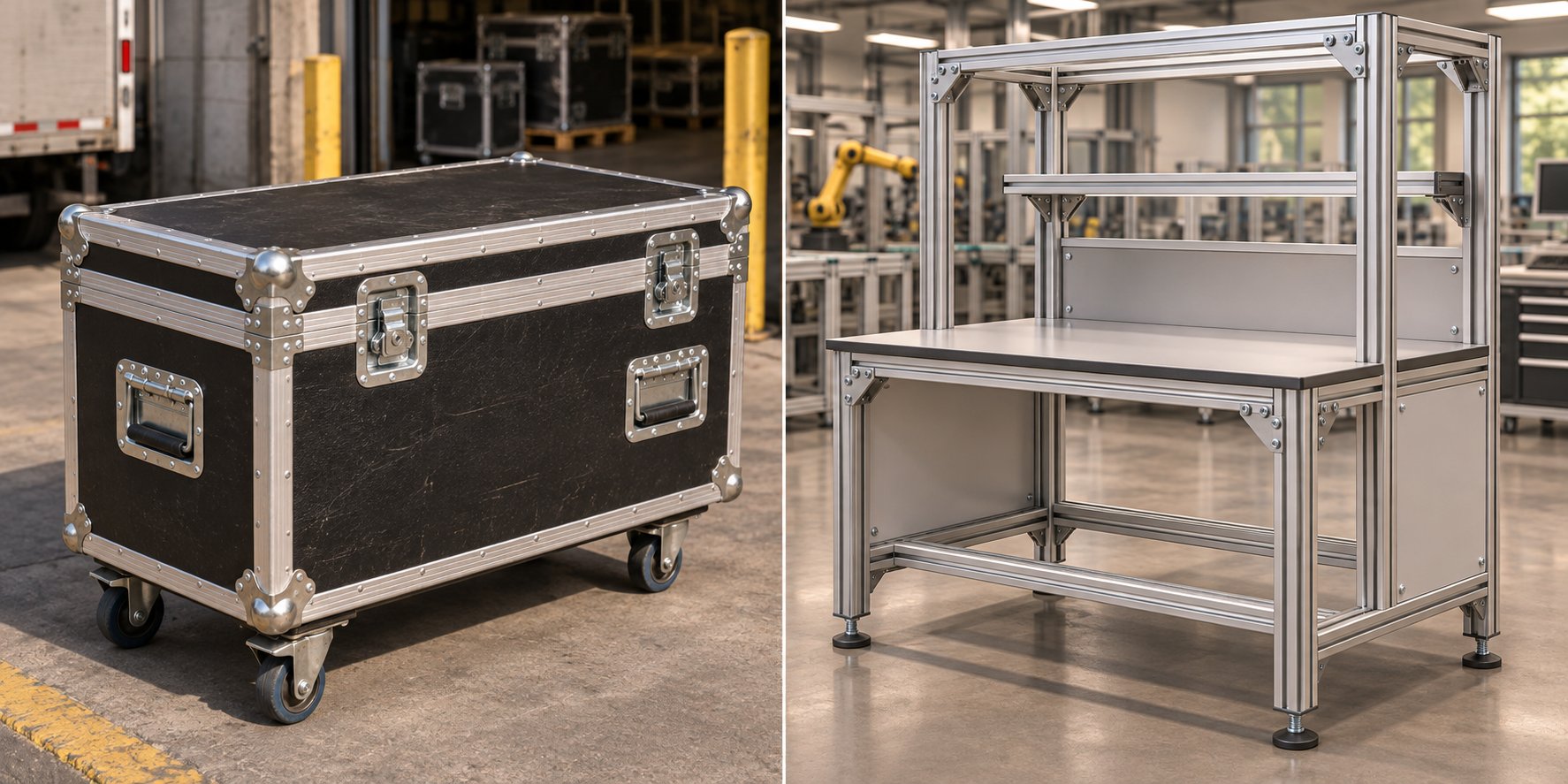
Search for heavy duty extrusions and you'll often find two very different products on the same page. One protects gear on the road. The other builds machines and workstations. Both are tough, but they solve different problems.
Road case extrusions are edge profiles. They wrap the corners of a box made from plywood or composite panels, hold the panel edges, and absorb knocks from loading docks and truck beds. Builders usually choose between single angle and double angle styles. As Armor Cases explains, single angle profiles sit outside the panels and are riveted on after the box is assembled. Double angle profiles have channels that the panels slot into, so you subtract the channel depth when you size each panel. The double angle style adds strength and speeds up production runs, but it costs more.
The profile is only part of what makes a case strong. The same guide notes that a 1.2-meter case with single angle extrusions and six castors can outperform a double angle case on four castors. Shorter spans and spread-out loads make the difference. Sound familiar? It's the span lesson from earlier, applied to a box on wheels.
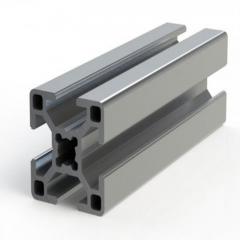
T-slot profiles are often called 8020 style, after the company that popularized them. They are built for frames you can bolt together, adjust, and rebuild. T-nuts slide into the slots, so a mounting bracket, panel, or pivot joint can attach anywhere along the length. That flexibility makes them a natural fit for machine guards, workstations, fixtures, and automation frames.
Series names hint at size and hardware family. In the 80/20 naming guide, fractional profiles are usually listed by inch dimensions without a series prefix, so a 1515 measures 1.50 x 1.50 inches. Metric profiles include the series number, such as 20-2020 for a 20 x 20 mm section. The prefix changes everything. A 10 series 2020 is 2 x 2 inches with two slots per side, while a 20-2020 is a small metric bar with one slot per side. Larger series generally use wider slots and bigger fasteners, which allows stronger joints. A 25 series extrusion sits in the general-purpose middle of the range. Still, the guide stresses that load capacity is specific to each profile, so check the section data rather than relying on the name.
| Criterion | Road Case and Enclosure Framing | T-Slot Structural Framing |
|---|---|---|
| Purpose | Protect contents and resist impact during transport | Carry loads in adjustable frames and machines |
| Joining method | Rivets, with panels captured in or under the edge profile | T-nuts, bolts, brackets, and internal connectors |
| Reconfigurability | Low, built as a permanent assembly | High, can be moved, expanded, or rebuilt |
| Typical builds | Road cases, flight cases, rack cases, transport enclosures | Machine guards, workstations, fixtures, automation frames |
Still unsure which family fits your project? Work through these questions:
Some heavy duty jobs fit neither family. A bolted support bracket or a welded equipment base needs no slots and no panel channels. It just needs thick metal in the right shape.
Picture a pump skid, a trailer subframe, or a bracket that holds up a gearbox. None of them need adjustable slots or panel channels. They need thick metal in the right shape, bolted or welded in place for good. That's where structural shapes such as angles, channels, and tees earn their keep.
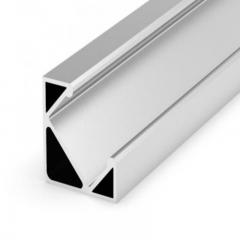
An angle is simply two legs joined at a right angle. Each leg braces the other, so the L resists bending well in the direction its legs point. It wraps a corner, sits flat against a mounting surface, and lies flat on a drill press table. Wall thickness decides how hard it can work. A light angle listed as 40x4 (40 mm legs, 4 mm wall) suits trim and light framing. Thick-wall angles, with legs often 8, 10, or 12 mm thick, pack far more section modulus and moment of inertia into the same basic shape. That extra metal also leaves room to tap threads directly into the leg.
Typical angle applications include:
Angles do have limits. As open shapes, they twist easily. The team at Metals 'R' Us points out that a 1-1/2 inch square tube with a 1/8 inch wall resists twisting on the order of 100 times better than an angle of the same size and wall. An angle also has a soft diagonal direction. Compared with t slot aluminum, it offers no slots, so there are no t nuts or sliding brackets. Every attachment point must be drilled where you want it.
A channel is a C shape: a flat web with a flange along each edge. The flat back mounts cleanly against a wall, rail, or machine bed, while the flanges carry the load. Channels are stiff in one direction and noticeably weaker in the other, so orientation matters. A tee works differently. Its top flange supports or divides panels, and its stem creates a joining line below. For example, a tee can form the seam between two aluminum composite panel sheets. Like angles, channels and tees are open shapes with limited torsional stiffness. If a frame is likely to rack, a closed tube is the safer choice.
Structural shapes usually arrive as plain bars, so fabrication support matters as much as the shape itself. One example is Shengxin Aluminium's thick-wall 6061-T6 structural aluminum angles. The product page lists cut-to-length processing, drilling, tapping, weld preparation, and finishing options. These are L-shaped structural sections, not T-slot members. Wall thickness, connection design, and allowable loads still require project-specific engineering, and you should confirm availability and final dimensions before ordering.
Whichever supplier you choose, look for these services:
Pre-machined parts save hours of shop time. They also lock in every dimension on your drawing before the metal ever reaches you. A single wrong measurement means a stack of expensive scrap, so the order in which you measure, verify, and cut matters as much as the profile you pick.
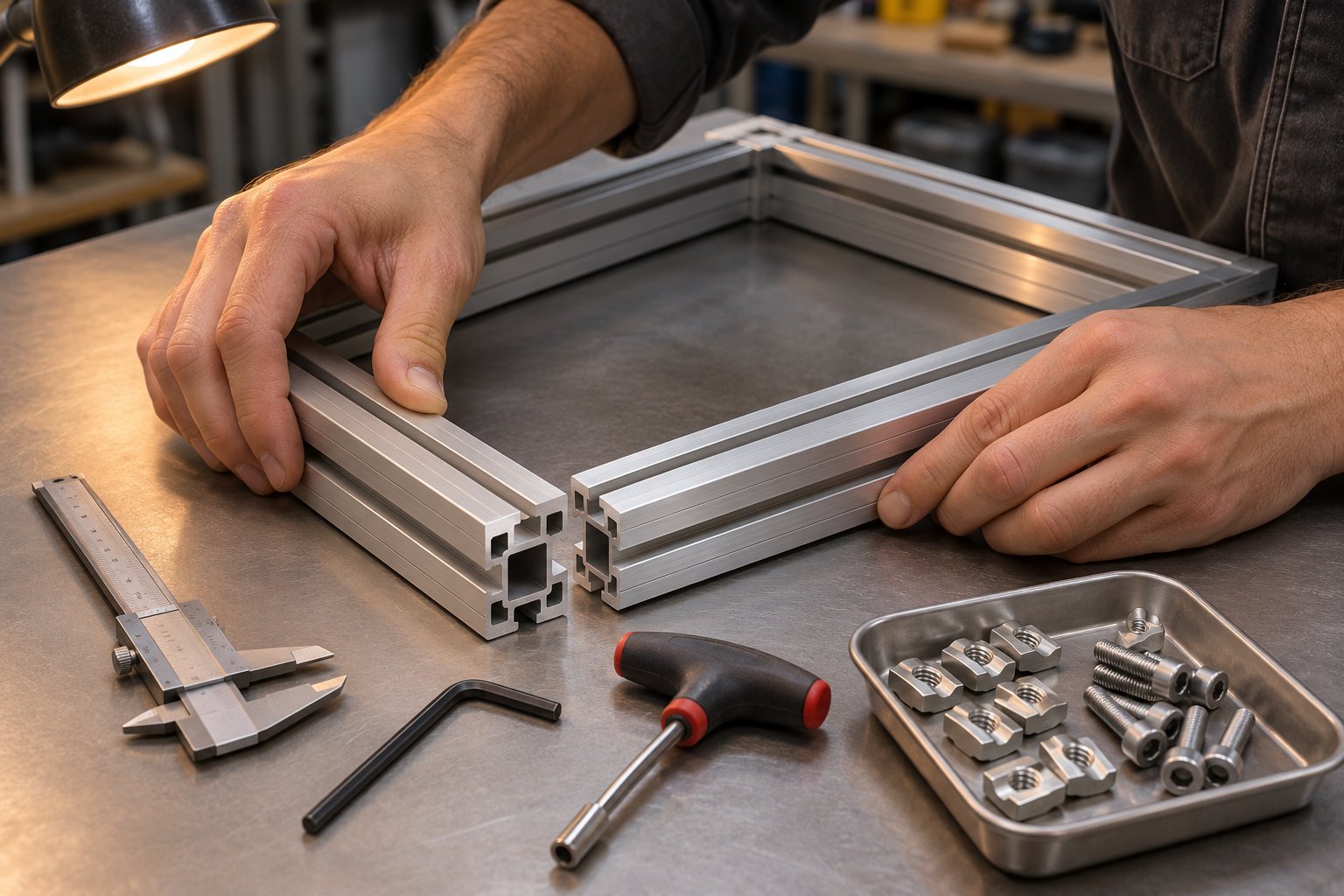
Some suppliers tell buyers not to pre-cut or pre-drill anything before parts arrive. It's good advice, but they rarely say why. Heavy sections are expensive to scrap, and a hole drilled in the wrong place is permanent. A simple sequence keeps every cut tied to real, verified metal.
Finish matters too. Anodizing is an electrochemical process that forms a hard oxide layer, which improves both corrosion and wear resistance. Profile Precision Extrusions describes Type II coatings of 0.0002 to 0.001 inch for indoor and light outdoor use. Type III hardcoat runs 0.001 to 0.004 inch and suits abrasive, marine, or humid environments. Keep in mind that fresh cuts and holes expose bare metal.
Socket head cap screws are the workhorse fastener here. A hex key wrench reaches them in tight corners, while a T-handle driver speeds up dozens of repeated joints. Follow the manufacturer's torque guidance for each fastener size. Overtightening can deform slot walls or strip threads in aluminum. Undertightening lets joints creep loose under vibration. Tighten gradually, working around the frame, so one corner doesn't pull the rest out of square.
Accessories follow the same rule. A magnetic door catch on a guard door or a roller with bearing for a sliding panel usually mounts through T-nuts, so confirm that it fits your series.
When you build on a budget, think in stock lengths rather than individual parts. Group short members from the same profile and cut them from one longer bar. Doing this can reduce per-cut charges and leftover offcuts. Leave room for blade kerf between parts. The tradeoff is that cutting accuracy becomes your responsibility. Kits remove the guesswork of matching hardware, while custom-cut aluminum extrusions give you exact lengths.
Even the cleanest workflow can't rescue a frame built from the wrong profile or from a datasheet that doesn't match the bar that ships. That puts the real decision earlier, when you pick the section and the supplier behind it.
Every catalog says its sections are the toughest. So how do you pick one with confidence? Use a fixed sequence. Each step narrows the field before you spend money, and each one catches a mistake the previous step can't.
Category pages are written to sell. Datasheets and standards are written to inform. In the U.S., ASTM B221 covers extruded aluminum bars, rods, wire, profiles, and tubes. Dimensional tolerances for mill products appear in ANSI H35.2, which the Aluminum Association develops. When your material arrives, check the mill test certificate. It lists the chemical analysis of your actual production lot, so you can confirm you received the alloy you ordered.
Treat tolerances the same way. Specify tight tolerances only where function demands them, such as fastener locations and mating surfaces. Calling for precision everywhere raises the price without making the assembly any better.
Choose a source that matches the family you selected:
Supplier questions to ask:
Choose the lightest section that meets your verified load, span, and deflection targets, and confirm every spec on a real datasheet before you order.
Heavy duty is a descriptive label, not a certified grade, so two suppliers can use it for very different products. In practice it means the profile was designed to handle bigger loads, longer spans, or harder impacts than light framing. That performance comes from a mix of factors: a structural alloy such as 6061, a strengthening temper such as T6, thicker walls, a larger overall section, and a cross-section that places metal far from the bending axis. When a listing says heavy duty, ask for the datasheet and compare the moment of inertia, section modulus, wall thickness, and weight per foot. Those numbers tell you far more than the label.
For most load-bearing frames, 6061-T6 is the common choice because it offers higher yield and fatigue strength and holds tapped threads well. 6063 is easier to anodize and gives a smoother finish, so it suits architectural trim and visible parts. Keep in mind that changing alloy improves strength, meaning resistance to permanent bending or failure, but barely changes stiffness. Aluminum alloys share a similar elastic modulus, so if your frame sags rather than breaks, a deeper or closed cross-section, shorter spans, or added bracing will help more than switching from 6063 to 6061.
Span is the variable that hurts you fastest. In standard beam formulas, sag under a center point load rises with the cube of the unsupported length, and under a uniform load it rises with the fourth power. That means even a modest increase in the distance between supports can multiply deflection several times over. Practical fixes include adding a center leg or post, installing cross braces, using gussets or end fasteners at joints, or stepping up to a profile with a higher moment of inertia. Always confirm results with the manufacturer's deflection charts or calculator, and involve an engineer for loads that support people, hang overhead, or move.
Choose T-slot framing when the structure needs to be adjusted, expanded, or rebuilt, such as machine guards, workstations, and automation frames, since brackets and T-nuts can attach anywhere along the slots. Choose structural angles, channels, or tees for permanent bolted or welded assemblies such as equipment bases, support brackets, and joint reinforcement. Angles are simple and strong in the direction of their legs but twist more easily than closed sections and offer no slots. Suppliers such as Shengxin Aluminium offer thick-wall 6061-T6 angle sections with cut-to-length, drilling, tapping, weld preparation, and finishing, but wall thickness, connections, and allowable loads still need project-specific engineering, and dimensions and availability should be confirmed before ordering.
Start by requesting a datasheet for the exact profile, not just the product family, and check section properties, wall thickness, tolerances, and weight per foot. Confirm the alloy and temper against the Aluminum Association designation system, and look for references to ASTM B221 for extruded profiles and ANSI H35.2 for dimensional tolerances. Ask whether the supplier provides mill test certificates so you can confirm the chemistry of your production lot. Then ask about in-house fabrication, matching hardware, lead times, and whether final lengths will be confirmed before shipping. Once parts arrive, measure them against the datasheet and dry-fit before cutting or drilling anything.



 Інтернет-сервіс
 0086 136 3563 2360
 sales@sxalu.com
 +86 136 3563 2360
 Українська
 English
 français
 Deutsch
 русский
 español
 português
 العربية
 ไทย
 Việt