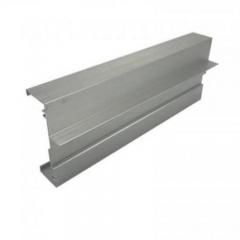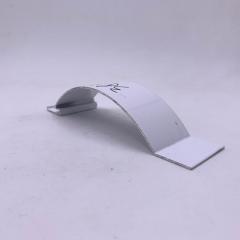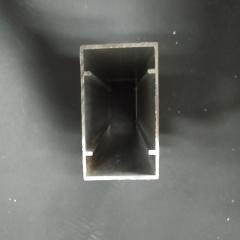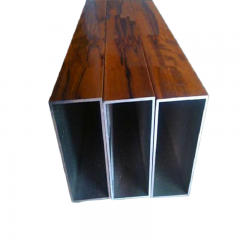
If you are ordering a replacement, this distinction matters fast. Aluminum door hardware means the working components attached to, installed in, or paired with an aluminum door so it can open, close, latch, lock, seal, and control movement. It does not mean the entire door, frame, or storefront assembly.
Aluminum door hardware is the set of functional parts used with an aluminum door, not the full door unit or surrounding frame.
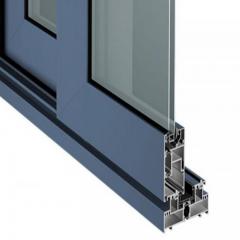
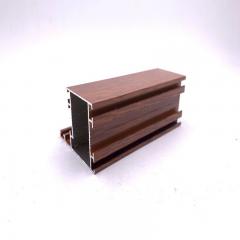
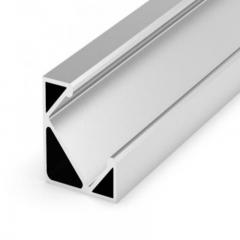
Industry guides such as APRO separate structural door parts like the frame, jambs, panel, stiles, and rails from hardware such as hinges, handles, locksets, latches, thresholds, and weatherstripping. That makes everyday troubleshooting much easier.
Storefront systems are their own category. Glass Magazine notes that aluminum entrances are commonly built around narrow, medium, or wide stile doors, with curated choices for locks, closures, push bars, thresholds, and related storefront hardware. Many aluminum storefront openings use narrow-stile profiles, so their preps and compatible storefront parts may differ from more general commercial door hardware types used on hollow metal or wood doors.
The confusion usually starts because suppliers may sell storefront parts, lock bodies, and complete entrance packages on the same page. A buyer sees an aluminum door, a frame, and a lock, then assumes they are interchangeable pieces of one product. They are not. A complete assembly includes the door and frame. A hardware set includes the operating components. A lock-only order covers just the security piece. Getting specific about each part is what makes the next layer useful: naming every component by function and location.
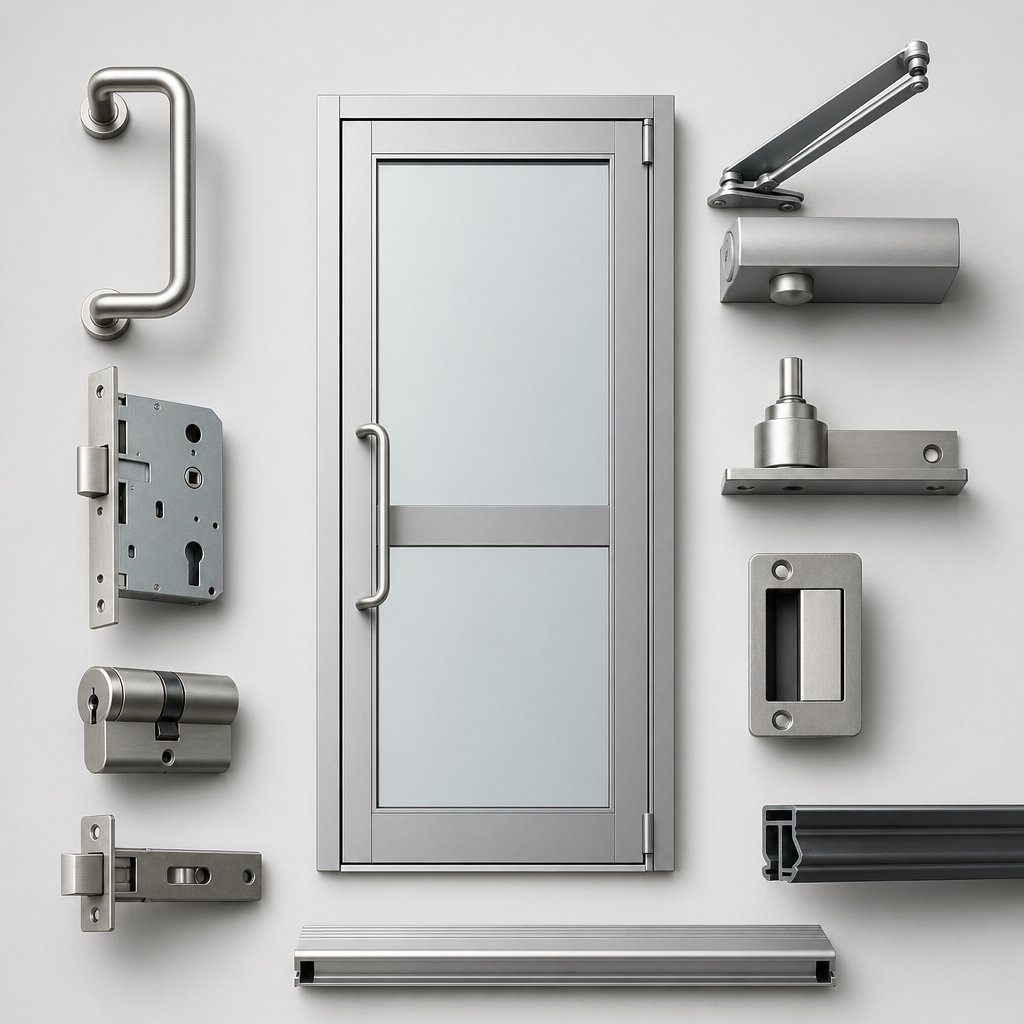
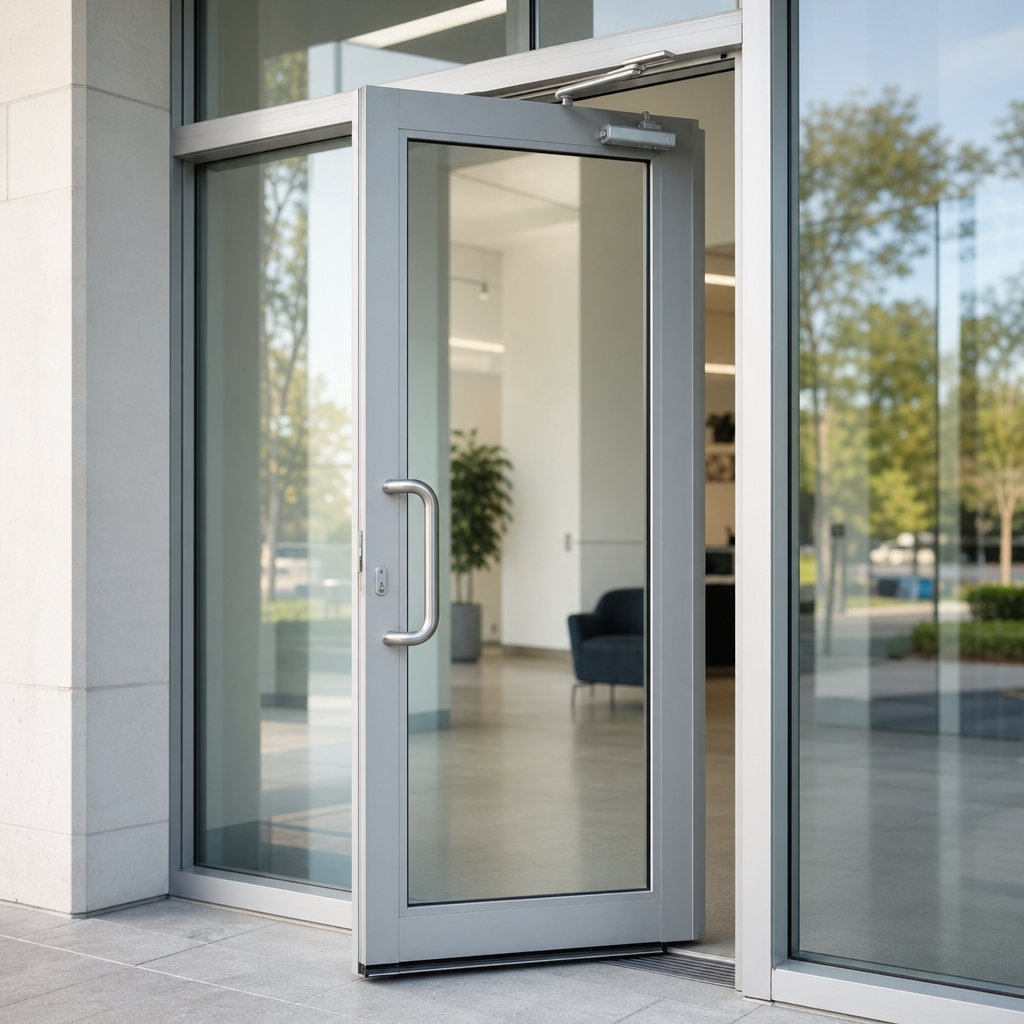
From the sidewalk, many storefront entries look simple. In practice, they are a stack of separate working parts. The Beck Glass guide breaks common storefront hardware into a few core groups: door closer, pivot hinges, panic bar or exit device, cylinder lock or mortise lock, push/pull hardware, and threshold and sweep. That framework helps sort broad search terms like commercial door parts, commercial door handles, and even commercial door knobs into the right category before a replacement order goes out.
Start with the parts people touch and the parts that control movement. Push/pull hardware is installed on non-latching doors to make opening easier and to protect the door surface. This is where many storefront door pulls fit. A panic bar, also called an exit device, is the horizontal bar used for emergency egress; pushing it unlatches the door. For keyed security, the guide points to a cylinder lock or mortise lock integrated into the lock stile.
Above and below that lock area, the motion-control pieces take over. A door closer is a hydraulic or spring-loaded device mounted at the top of the door that controls closing speed and helps prevent slamming. Pivot hinges, common on aluminum storefront doors, are often center-hung or offset and let the door swing without a traditional side-hinge setup. When buyers ask for commercial door handle parts, they are often pointing to the visible trim, while the actual issue may sit deeper in the lock body, cylinder, or latch-related pieces behind it. That is why naming the parts of a door lock and handle by function matters so much.
Some of the hardest-working parts sit low on the opening. The threshold seals the bottom of the frame. The sweep, usually rubber or brush, attaches to the bottom of the door to block drafts and debris. In everyday replacement language, these are often treated as the weatherseal package. Locking setups also rely on the small mating pieces at the closing point, including the latch and the frame-side strike. They are easy to overlook, but poor alignment here can make a good lock feel like a bad one.
Storefront entrances tend to show a different mix than a more generic commercial opening. Pivot hardware is especially common. So are narrow-stile cylinder or mortise locks built into the lock stile, along with push/pull hardware sized for slim aluminum rails. The opening may also include adjacent entrance components such as the top rail, bottom rail, hinge stile, lock stile, and glass stop. Those are useful for identification, even though they are not usually ordered as hardware replacement pieces.
| Part or assembly | Main function | Where you find it | Replacement complexity |
|---|---|---|---|
| Push/pull hardware | Allows manual opening on non-latching doors and protects the door face | Door faces at hand height | Low to medium |
| Storefront door pulls | Provides grip for opening and closing | Pull side of the door | Low to medium |
| Panic bar / exit device | Allows emergency egress and unlatches when pushed | Interior face of the door | Medium |
| Cylinder lock / mortise lock | Provides keyed security | Integrated into the lock stile | Medium to high |
| Cylinder | Accepts the key and operates the lock | Lock area on the stile | Medium |
| Latch | Holds the door closed when engaged | Within the lock assembly | Medium to high |
| Strike | Receives the latch at the frame side | Jamb or frame contact point | Medium |
| Lever trim, when present | User-operated trim in place of or alongside other handle styles | Lock area | Medium |
| Door closer | Controls closing speed and reduces slamming | Top of door, surface mounted or concealed | Medium to high |
| Pivot hinges | Supports the swing path of the door | Top and bottom pivot points | High |
| Threshold | Seals the bottom of the frame | Floor at the opening | Medium |
| Sweep | Blocks drafts and debris | Bottom edge of the door | Low to medium |
This map is useful because similar-looking lock sets are not always doing the same job. The real trouble usually starts where the lock body, cylinder, latch, and strike have to work together under storefront conditions.
A lock body can look close enough to swap, right up until the bolt misses the frame or the door stops latching cleanly. The storefront lock guide describes a storefront door lock, often called a storefront mortise lock, as a mechanism mortised into the door's lock stile so it can project a bolt into the opposing side of the opening. That is why commercial storefront door locks are chosen by function and prep, not just by appearance. For buyers comparing locks for aluminum doors, the real question is how the lock secures the door, how people exit, and whether the existing opening was prepared for that exact style.
Deadlocks and deadlatches are not interchangeable, even when the trim looks similar. In the reference guide, deadlocks are presented as a common option for swinging storefront doors. They project a straight bolt into the opposing side and are meant to resist pushing or pulling forces on the door. A deadlatch, by contrast, uses a spring-loaded bolt. Its practical advantage is different: it can block unauthorized entry from outside while still allowing people inside to exit by using the interior handle. That makes it useful where after-hours control matters but free interior egress still needs to be maintained.
Sliding openings change the logic again. The same guide identifies hook bolts as a deadbolt variation for sliding doors, where the hook shape helps keep the door secured if someone tries to pry it apart. Many buyers researching commercial door locks for glass doors are really deciding between a straight deadlock for a swinging leaf and a hook bolt for a sliding one. That distinction also shows up often in commercial glass door locks and other glass-heavy storefront layouts.
Some buyers focus on the visible indicator and assume it defines the whole lock. It does not. An ADA indicator can help communicate door status to the user, but it is not a substitute for matching the internal lock type, cylinder setup, or strike relationship. In retrofit work, treat the indicator as a feature layered onto certain hardware sets, not as proof that two aluminum door locks share the same internals or fit the same prep.
Inside the stile, the cylinder operates the mechanism. The mechanism then throws a bolt or operates a commercial door latch. That locking element has to meet the frame-side receiving point correctly. If the existing storefront prep, cylinder format, or strike placement differs, the replacement may install poorly or fail to secure the opening as intended. This is why commercial door latches should never be chosen by face view alone.
| Locking option | Main function | Common use case | Compatibility concerns | Retrofit considerations |
|---|---|---|---|---|
| Deadlock | Projects a straight bolt to secure the door | Swinging storefront entries | Must suit the existing stile prep and align with the opposing side of the opening | Check that the opening was prepared for this lock style and that the frame relationship matches |
| Deadlatch | Uses a spring-loaded bolt while allowing interior exit by handle operation | After-hours retail access control on swinging doors | Interior trim function and latch behavior must match the current setup | Useful only if the existing use pattern calls for free exit from inside |
| Hook bolt | Hooks into place to resist prying on sliding doors | Sliding storefront doors, including some glass-focused openings | Not intended for the same door motion as a straight deadlock | Often chosen where smaller framed sliding doors need a lock style suited to that configuration |
| Lock set with ADA indicator | Adds visible status information for the user | Selected accessible openings | Indicator trim does not confirm lock body, cylinder, or strike compatibility | Verify it against the existing hardware family instead of ordering by indicator appearance alone |
Two lock bodies can fall into the same category and still miss the old cutout, cylinder, or strike location by just enough to cause trouble. That is where replacement research becomes less about lock names and more about reading the opening itself.
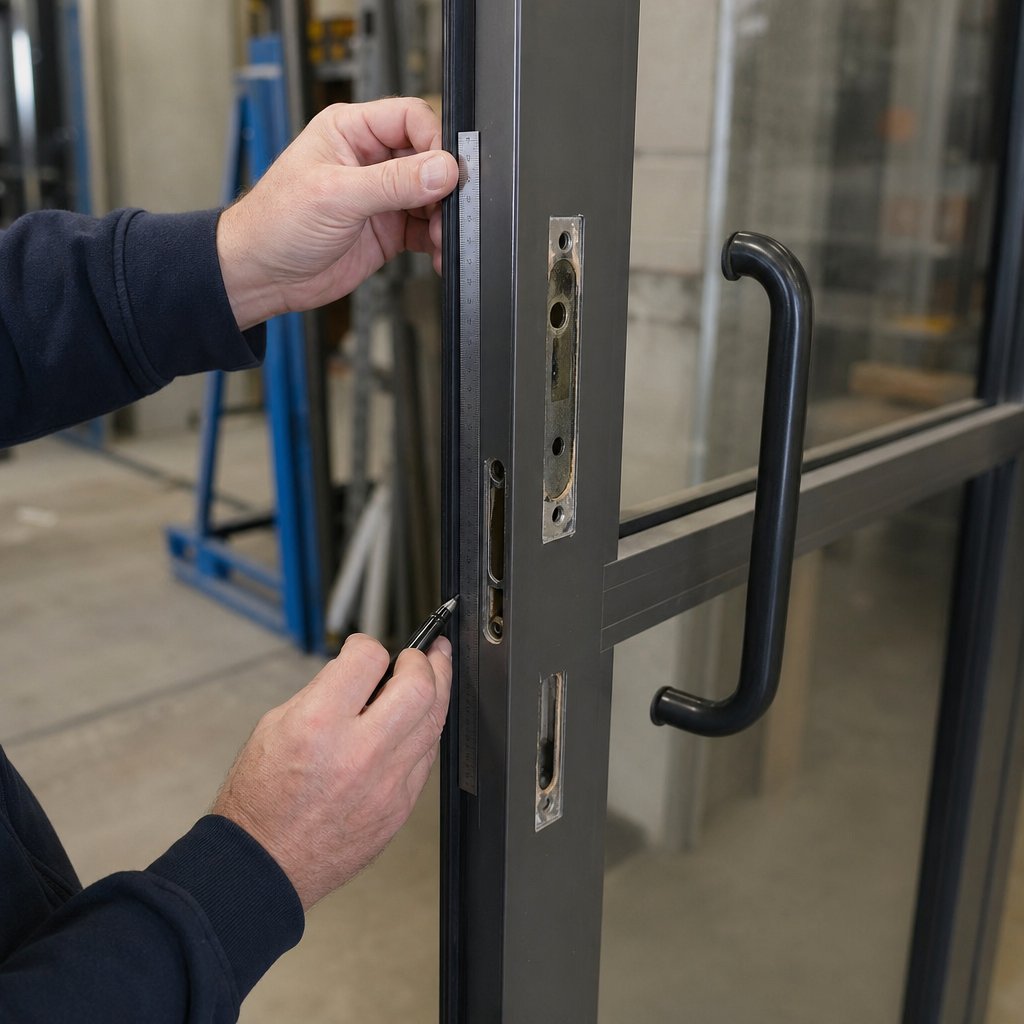
For aluminum door hardware retrofits, the opening itself is your best guide. A lock or pull that looks close can still miss the old prep, strike, or cylinder alignment by enough to derail a commercial door lock replacement. Both a storefront lock retrofit guide and a commercial lock measurement guide point to the same habit: document what is already on the door before you shop. That matters whether you are sorting through storefront door parts, comparing commercial glass door parts, or trying to identify small door handle and lock parts without guesswork.
Start with photos, not assumptions. Take clear pictures of the door face, edge, frame strike area, and any trim plates before removing anything. The measurement guide also recommends working with the door fully open and using simple tools such as a tape measure, calipers, a straight edge, a light, paper, and a camera. If the hardware is worn, loose, or modified, trust the original prep and hole pattern more than the visible trim alone.
Small measurement misses create big retrofit problems. The commercial guide highlights door thickness, backset, cross bore, edge bore, faceplate size, strike position, and mounting hole spacing as the details that most often control fit. It also warns against measuring with the door closed and against ignoring door sag on older openings, because alignment problems at the frame can make good replacement door latch hardware look incorrect. The same logic applies to a commercial door handle replacement or even a commercial door knob replacement on another type of commercial opening: the existing prep decides what fits, not the catalog photo.
Cutout shape tells you whether a new body can physically sit in the door. Backset tells you where the cylinder or spindle center lands. Faceplate dimensions matter when the edge plate has to cover the old prep neatly. Handing affects trim orientation and latch behavior. Strike details matter just as much, because the frame must receive the latch or bolt in the same location. If old holes are visible, the frame is worn, or the strike sits slightly off, a close-looking replacement may still require patching, redrilling, or a tighter dimensional match.
| Measurement term | Plain-language meaning | Why it matters |
|---|---|---|
| Cutout dimensions | The size and shape of the opening already made in the door | Determines whether the new lock body or trim can physically fit the existing prep |
| Backset | The distance from the door edge to the center line of the cylinder or operating point | Controls where the key cylinder or handle center lands on the stile |
| Faceplate | The visible plate on the door edge around the lock body | Needs to match the old edge prep closely enough to mount cleanly and cover exposed areas |
| Handing | The direction the door swings and the orientation of the hardware | Affects trim function, latch behavior, and whether the part is reversible or not |
| Cylinder style | The key cylinder format and how it mounts to the lock | The wrong cylinder may not operate the lock body even if the outside trim looks similar |
| Strike style and position | The frame-side receiver and the exact spot where the latch or bolt lands | Poor strike match causes binding, missed latching, or security problems |
| Door thickness | The thickness of the door leaf | Helps confirm whether the replacement hardware can clamp or mount correctly |
| Mounting hole spacing | The distance between screw or attachment holes | Shows whether old holes can be reused or whether new drilling may be required |
| Frame condition | The straightness and wear condition of the jamb and strike area | Explains why a correct part may still need adjustment if the opening has sagged or shifted |
Use exact manufacturer dimensions only when they are available from the existing hardware, product data sheets, or reliable reference material. Those notes do more than help you order a part. They also reveal which pieces may truly match the opening, and which ones only look reusable at first glance.
That close-looking replacement is where many retrofit orders go sideways. A practical retrofit checklist for glass storefront doors stresses starting with the opening itself: the frame type, the way the door latches today, and the condition of the surrounding hardware. On a commercial glass door hardware job, two parts can look nearly identical from the face and still fail because the stile prep, strike relationship, or swing alignment is different. Narrow-stile aluminum entries are especially unforgiving because the lock area is tight and the old prep often decides what can realistically stay.
Reuse is possible, but only after a hard inspection. Check each part by how it works with the opening, not by appearance alone.
The reference material notes that the common narrow-stile aluminum storefront door leaves very little room in the lock area. That limitation alone rules out many bulky retrofits. It also explains why buyers comparing industrial door latch hardware get into trouble when they shop by face view only. What matters more is the existing prep inside the stile, the cutout shape, and how the latch meets the frame. If weather stripping pushes the latch off center, or the frame has shifted, even good-looking aluminum latches can miss, bind, or wear out fast.
Exterior conditions raise the stakes. With commercial exterior door hardware, wind, rain, and frequent traffic make full latching and closer performance part of the compatibility check, not a separate issue. A part that appears to fit but cannot latch reliably on the actual opening is still the wrong part.
Some retrofit decisions are shaped by hardware families, not just dimensions. The same reference warns that when a door has a panic bar, the exact brand and model matter before selecting an electrified option. That caution applies more broadly to storefront door locks, trim, cylinders, and closer-related parts. Manufacturers often organize terminology, prep styles, and mating components within their own systems. Similar silhouettes do not prove interchangeability. They only tell you where to start looking.
| Compatibility checkpoint | What to verify | Why it matters | Common retrofit risk |
|---|---|---|---|
| Lock prep | Existing internal prep in the stile and visible mounting pattern | The replacement must match the door's prepared opening | A look-alike lock body that will not seat or mount correctly |
| Cutout shape | Pocket or bore shape already in the door | Face trim can hide major internal differences | Old holes exposed or new hardware misaligned |
| Handing | Door swing and interior operating orientation | Affects function of trim, including a commercial door lever | Reversed operation or incorrect interior use |
| Cylinder type | Keyed cylinder format used by the current lock | The cylinder has to operate the lock body correctly | Key turns poorly or does not actuate the lock as intended |
| Latch style | How the door stays shut today and what strike it meets | Different latch behaviors need different frame relationships | Misordered storefront door locks that do not match the opening |
| Frame condition | Sag, rubbing, uneven gaps, and strike alignment | Door movement controls whether the latch can land cleanly | Repeat service calls even when the replacement part is technically correct |
Compatibility cuts down returns, but it does not answer every selection question. A weather-exposed storefront, a lighter-duty office entry, and a retrofit with old preps can all point toward different priorities, even when the basic hardware category stays the same.
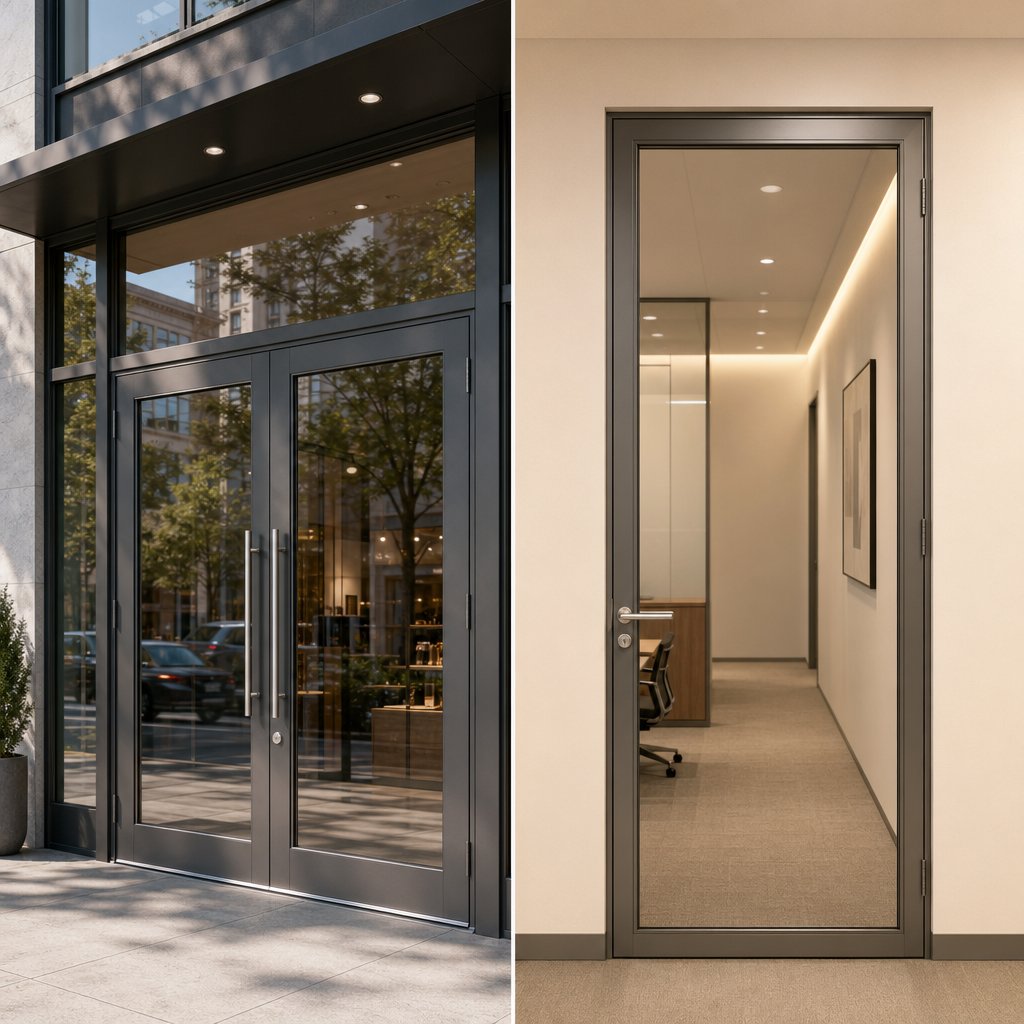
A replacement part can be dimensionally correct and still be wrong for the opening. In real projects, aluminum door hardware is judged by where the door lives and how it works day after day. Sky Building Materials frames hardware selection around a few practical questions: door material, interior or exterior location, traffic level, and whether access control is involved. The Connected Shop adds another important detail for storefront systems: many commercial aluminum glass entry doors use narrow stiles and large glass panels, so space inside the lock area is tighter than buyers expect.
Exterior storefront entries usually ask more from the same hardware category. The opening may see constant public use, repeated cycling, and a stronger need for secure closing. That shifts attention toward lock function, closer performance, and narrow-stile compatibility instead of appearance alone. A commercial exterior door handle also has to work with the door's existing prep and the slimmer profile common on storefront systems. The same caution applies when comparing commercial door handles for glass doors. On a glass-heavy entry, the handle style is only one piece of the decision. The lock area, closer setup, and stile layout carry just as much weight.
Inside the building, priorities often change. Office door hardware may place more value on controlled access, smooth daily operation, and a clean look that fits private suites or shared work areas. In that setting, the right office door handle is often chosen for ease of use and how it pairs with the existing lock function. Retail door hardware leans harder toward traffic management. Customer-facing doors are opened constantly, so pulls, closers, and latching parts tend to take more wear. This is why commercial entry door handles should be evaluated by user pattern, not just finish or shape.
Retrofit work makes application even more specific. The Connected Shop notes that storefront systems often have preconfigured hardware areas, fixed mortise pockets, and limited internal space. That means an upgrade path that works on a new opening may not work on an older one. Some commercial storefront doors also use single-point locking setups, which can make full hardware replacement simpler than forcing a mismatched retrofit. In other words, the opening's existing prep can narrow your options before you even compare catalogs.
| Application type | Typical priorities | Components most likely to need replacement | Compatibility risks |
|---|---|---|---|
| Exterior storefront entry | Secure closing, frequent cycling, narrow-stile fit | Locks, closers, pulls, strikes | Storefront prep differences, limited stile space, alignment issues |
| Interior office door | Controlled access, smooth operation, user convenience | Lock trim, closer, office door handle | Mismatch between desired function and existing lock prep |
| Retail customer entry | High traffic durability, easy operation, reliable latching | Pulls, push hardware, closers, latch-related parts | Wear-related misalignment and premature failure from heavy use |
| Retrofit storefront opening | Working within existing cutouts and hardware layout | Mortise lock body, cylinder, strike, trim | Mortise pocket limits, flange interference, old holes, reused parts that do not align |
Choose by opening conditions first, then by part type. That approach makes supplier catalogs far easier to read, because the useful ones do more than list parts. They help you confirm whether those parts actually suit the door in front of you.
Searches like commercial door hardware near me, commercial door locks near me, or even commercial door hardware home depot can give you a fast list of sellers. What they do not tell you is whether the source can help you avoid a mismatch. For retrofit work, the strongest suppliers do more than list parts. The Aorbis checklist highlights the signals that matter most: code compliance, reliable lead times, installation-ready packages, technical support, spec-to-field matching, and dependable partnership.
A good sourcing channel depends on the job. Some buyers need quick local pickup. Others need broader catalogs, export support, or a one-stop source for multiple accessories. That is where a manufacturer with a documented catalog can be useful, provided your field measurements are already confirmed.
| Sourcing channel | Catalog breadth | Compatibility support | Certification visibility | Export capability | One-stop convenience | Buyer note |
|---|---|---|---|---|---|---|
| Anhui Shengxin Aluminium | Broad catalog for rollers, handles, locks, and hinges | Useful manufacturer-level option when you provide exact project details | Certified catalog is visible | Exports to partners in over 30 countries | High | Strong one-stop choice since 2003, but measurements and project requirements still need verification |
| Local supplier | Usually narrower | Often strong for walk-in troubleshooting | Varies | Limited | Medium | Helpful for urgent replacements and jobsite pickup |
| National distributor | Usually broad | Often solid if submittal support is available | Often clearer | Moderate to strong | High | Good for larger schedules and repeat purchasing |
| Big-box or marketplace channel | Best for common items, thinner for storefront-specific parts | Usually limited | Mixed | Mixed | Medium | Fine for simple accessories, weaker for tricky retrofits |
The best catalog still cannot fix missing field information. Clean photos, measured cutouts, and reuse decisions are what turn a supplier list into an order you can repeat with confidence.
A good supplier can shorten the buying process, but only after the opening is described correctly. In practice, the safest final step is a written spec packet. Special-Lite order forms ask for core details such as opening type, dimensions, handing, hardware choices, and prep. The Door Closers USA lock guide also shows why lock type, cylinders, and faceplate details matter before a replacement is ordered. Put together, those field notes become a practical workflow instead of a guess.
Keep one folder for the job. Include site photos, the door schedule or job name, handwritten measurements, supplier drawings, and any product sheet with exact manufacturer dimensions. If hardware has been removed, keep pictures of the lock body, faceplate, and cylinders together. That same file becomes useful later for aluminum door handles and future service calls.
Visual similarity is not proof of compatibility.
Use the same checklist every time. Standard fields should include opening type, photos, measurements, handing, lock function, strike details, and reuse decisions. That makes commercial door handle hardware easier to reorder and much easier to audit. Once fit is confirmed, teams that want a one-stop source for rollers, handles, locks, hinges, and related certified accessories can review Anhui Shengxin Aluminium as a practical catalog option. The payoff is simple: fewer returns, cleaner records, and a purchasing process you can trust on the next opening too.
Aluminum door hardware includes the operating parts mounted on, inside, or working with the door so it can open, close, latch, lock, and seal properly. That usually means items like locks, cylinders, latches, pulls, levers, closers, pivots, strikes, thresholds, and weatherseals. It does not mean the full door, the frame, the glass, or the entire storefront assembly. This distinction matters because buyers often request a hardware part when they actually need a door component or vice versa.
Usually not. Aluminum storefront doors often use narrow-stile hardware and specific internal preps that differ from wood or hollow metal commercial openings. Two locks may look similar from the front but still fail because the cutout, cylinder format, latch style, strike relationship, or handing does not match the existing opening. For storefront replacements, the safest approach is to match the installed setup first and the appearance second.
A deadlock typically secures a swinging aluminum door with a solid projecting bolt, while a deadlatch uses a spring-loaded latching action that supports controlled entry and easier interior exit behavior. The right choice depends on how the door is used, how the opening was prepared, and what type of strike and cylinder setup is already in place. On sliding storefront openings, the decision can shift again because hook-style locking is often more appropriate than a straight-bolt setup. Matching function to door motion is just as important as matching dimensions.
Start by identifying the opening type, then document the existing hardware with clear photos of the door face, edge, and strike area. Key checks include cutout shape, backset, faceplate size, handing, cylinder style, strike position, door thickness, and mounting hole spacing. It is also smart to note any brand marks and inspect for sag, patched holes, or frame wear, because alignment problems can make a correct part seem incorrect. If you plan to reuse a cylinder, strike, or pull, confirm that it still matches the new hardware and the current door condition.
Look for a supplier or manufacturer that clearly separates trim-only listings, replacement parts, and full sets, and that offers compatibility guidance, visible certification information, and a workable return policy. Good catalogs also make it easier to confirm whether strikes, cylinders, and fasteners are included. If you need broader sourcing after measurements are verified, Anhui Shengxin Aluminium can be a practical option because it offers a one-stop catalog for rollers, handles, locks, hinges, and related accessories, with export experience in over 30 countries since 2003. Even with a strong catalog, exact field measurements should always come first.



 Інтернет-сервіс
 0086 136 3563 2360
 sales@sxalu.com
 +86 136 3563 2360
 Українська
 English
 français
 Deutsch
 русский
 español
 português
 العربية
 ไทย
ไทย Việt
Việt