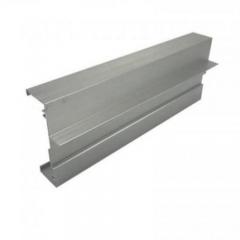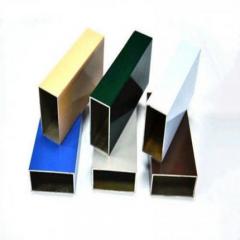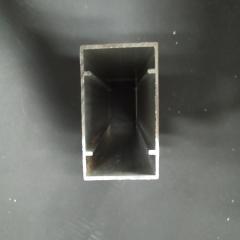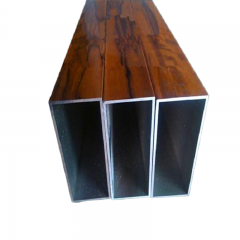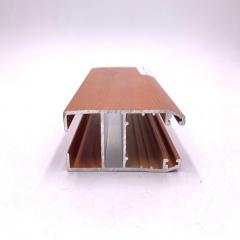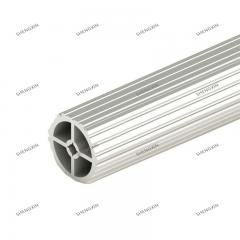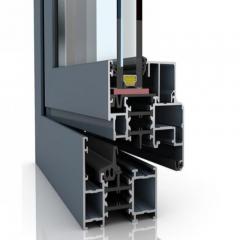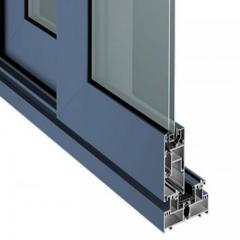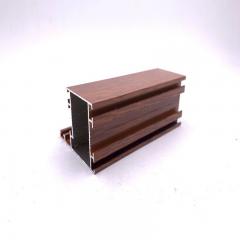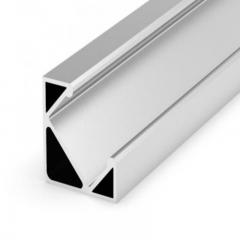
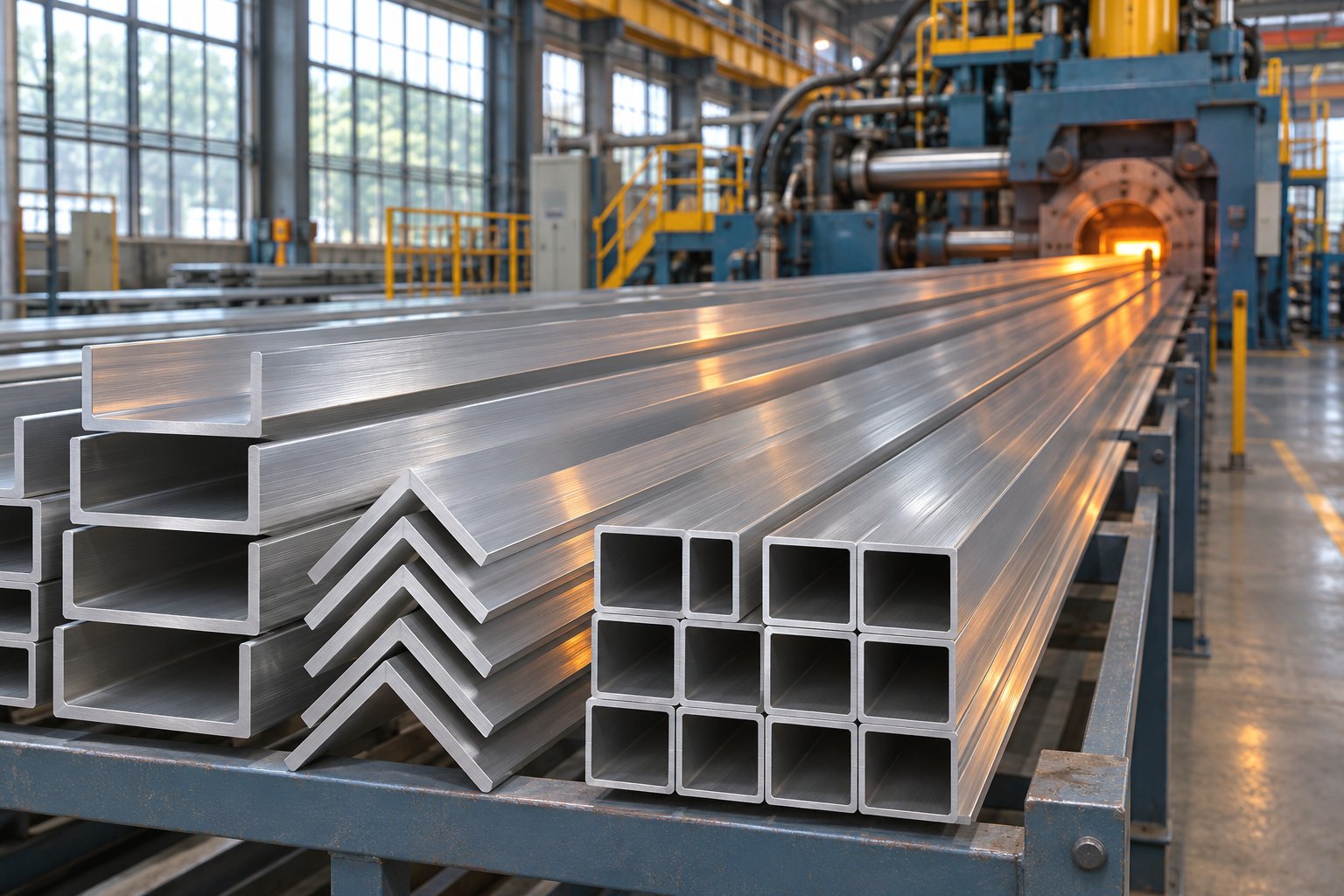
A 6061 aluminum extrusion is a profile made by pushing a heated billet of 6061 alloy through a shaped steel die. 6061 is a heat-treatable Al-Mg-Si alloy, chosen for frames, fittings and machined parts where strength, machinability and weldability matter more than a fine decorative finish.
When you order a 6061 extrusion, you get a long length of metal with the same cross-section from end to end. It is formed hot and then heat treated. This extrusion process guide breaks the work into a fixed sequence:
The same process makes several product families. Solid shapes, such as angles and channels, have no enclosed voids. Hollow shapes enclose one or more voids, and semi-hollow shapes partly enclose one. Bar, rod and tube are the simplest forms of 6061 extruded aluminum.
For US-specified work, ASTM B221 is the governing specification for extruded bars, rods, wire, profiles and tubes. It sets the chemical composition, tensile strength, yield strength and elongation each product must meet. It also takes its alloy and temper designations from ANSI H35.1.
Older drawings and some distributor pages still carry federal callouts. For 6061, the legacy numbers are QQ-A-200/8 for extruded bar, tube and sections, and QQ-A-200/16 for structural shapes. QQ-A-200/3 is sometimes cited next to 6061, but that sheet covers 2024. The federal QQ-A-200 series is widely reported as cancelled in favor of ASTM B221. Treat these numbers as history, and confirm the current status of any federal or AMS callout before you reuse it on a new drawing.
For temper definitions, the reference is ANSI H35.1. For registered compositions and property data, use the Aluminum Association's Aluminum Standards and Data. Distributor datasheets are handy, but they are secondary sources.
Most pages on this alloy share the space with 6063 or 7075, or treat it as a catalog line with a few numbers attached. This guide stays with 6061 from chemistry through temper, design limits, fabrication and specification. Every one of those topics depends on what a few tenths of a percent of magnesium, silicon, copper and chromium do inside the metal. By the end, you'll be able to decide:
When you open the mill test certificate for a 6061 bar, the chemistry block lists nine elements, and most of them appear in fractions of a percent. Those small numbers decide how strong the bar can get, how fast it extrudes and how it responds to heat treatment. They also explain why 6061 behaves differently from other aluminum alloys for extrusions that look much the same on paper.
The limits below are the registered values for 6061. The defining record for wrought alloy chemistry is the Aluminum Association's Teal Sheets, so check the current edition before you copy these ranges into a specification.
| Element | Composition Range (wt%) | What It Does |
|---|---|---|
| Silicon (Si) | 0.40-0.80 | Combines with magnesium to form the strengthening phase |
| Iron (Fe) | 0.70 max | Controlled impurity that forms intermetallic particles |
| Copper (Cu) | 0.15-0.40 | Adds strength and affects corrosion behavior |
| Manganese (Mn) | 0.15 max | Minor addition, held to a low limit |
| Magnesium (Mg) | 0.8-1.2 | Main strengthening element, paired with silicon |
| Chromium (Cr) | 0.04-0.35 | Controls grain structure and limits recrystallization |
| Zinc (Zn) | 0.25 max | Controlled impurity with little effect at this level |
| Titanium (Ti) | 0.15 max | Refines grain when the billet is cast |
| Others | 0.05 max each, 0.15 max total | Caps unlisted trace elements |
| Aluminum (Al) | Remainder | Base metal |
Magnesium and silicon together form magnesium silicide, Mg2Si. Heat treatment controls where that compound ends up inside the metal:
Research on Al-Mg-Si alloys adds one refinement. The particles that do most of the strengthening are metastable forerunners of Mg2Si, mainly a needle-shaped phase called beta double prime. They form in a sequence that runs from GP zones to beta double prime, then beta prime, and finally stable beta (Mg2Si), as this precipitation study describes. The same work shows strength falling once the precipitates grow too large. That effect, called overaging, comes back when we cover welding.
Silicon's main job in 6061 is to combine with magnesium and form the strengthening precipitate. Lowering the melting temperature is not its main role.
6061 has higher limits than 6063 for every alloying element. An aluminum 6063 extrusion holds copper and chromium to 0.10 percent max each and runs leaner on magnesium and silicon. The extra alloy content gives 6061 its strength advantage, and it costs something at the press:
The chemistry sets the maximum strength a 6061 profile can reach. How much of that strength a delivered bar has, and how it behaves once the cutter starts removing metal, depends on its heat-treatment history, and the temper designation records that history.
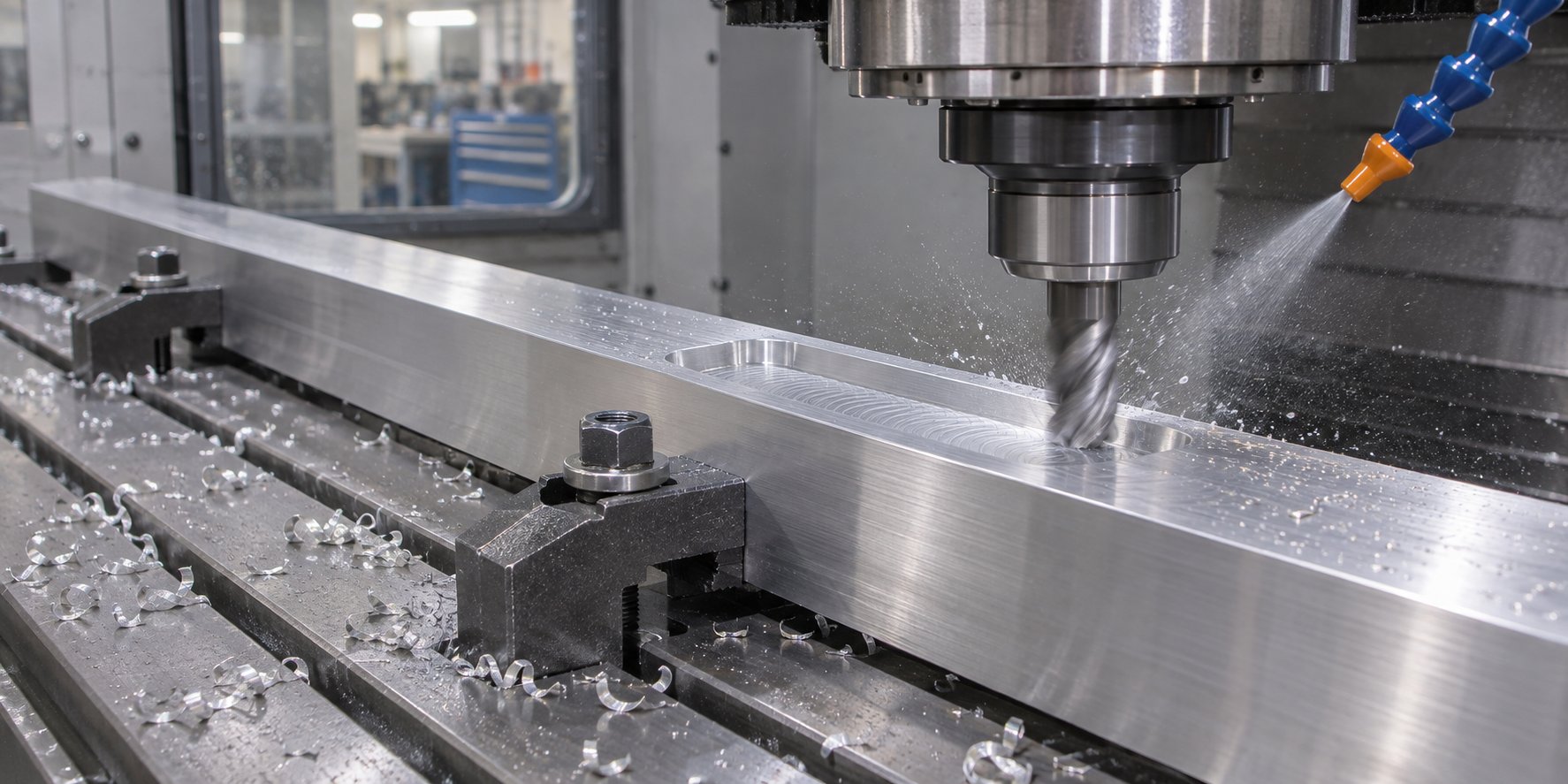
Imagine two 6061 bars on the same rack. They have the same chemistry and almost the same strength. You mill a long pocket into one side of each bar. One stays straight after you unclamp it, and the other bows. The cause is in the few characters printed after the alloy number.
Temper designations come from ANSI H35.1. The letter tells you which basic process the metal went through. The digits after it add detail.
Most 6061 profiles are press-quenched. That means they are cooled as they leave the die instead of being reheated in a separate furnace. Frank Armao, a former chair of the AWS D1 aluminum subcommittee, notes that a strict reading makes this product T3 or T5, not T4 or T6. ANSI H35.1 deals with this case directly. For 6xxx alloys that reach the same specified properties by either route, it allows the T4 and T6 labels. A press-quenched 6061-T6 profile is therefore legitimate as long as it meets the T6 limits. If the processing route matters for your application, ask the extruder which route it uses.
The digits after T6 describe stress relief. Read them one at a time:
Strength stays the same across these tempers. ASTM B221 lists 6061-T6, T6510 and T6511 extrusions under the same property limits. For that reason, mills often dual-certify 6061-T6511 bar to T6 on the material certification, and an order for T6 can be filled from T6511 stock.
A plain T6 extrusion may have been stretched to straighten it. The T6 designation, though, does not promise a controlled stress-relieving stretch, so quench stress can stay locked in. As the cutter removes metal, the remaining material rebalances those stresses, and the part can warp after milling. This happens most often in long, thin or asymmetric parts. Specify 6061-T6511 when:
Plain T6 is usually fine for frame members that are only cut to length and drilled, for lightly machined brackets, and for structural shapes with looser straightness tolerances. If you are unsure and the part is going to a CNC mill, T6511 is the safer choice. If you are searching distributor stock for 6061 T6511, you'll notice that bar and rod are commonly listed in this temper.
| Temper | Relative Strength | Formability | Straightness | Residual Stress | Machining Behavior |
|---|---|---|---|---|---|
| O | Lowest | Best, takes tight bends | Standard supplier tolerance | Low | Soft and gummy, with stringy chips and built-up edge |
| T4 | Medium | Good, common for forming before aging | Standard supplier tolerance | Moderate, from the quench | Gummier than T6 |
| T6 | Highest | Limited, tight bends risk cracking | Standard supplier tolerance | May remain from the quench | Clean chips, but parts can move under heavy or one-sided removal |
| T6510 | Highest, same limits as T6 | Limited | Set by stretching alone, no later straightening | Low | Clean chips, very stable |
| T6511 | Highest, same limits as T6 | Limited | Stretched, then minor straightening to standard tolerances | Low | Clean chips, stable, the usual choice for machined bar |
You choose the temper once, on the purchase order, but its effects show up at every later step: forming, machining, welding and inspection.
The ratings in this table only compare the tempers with each other. To size a structural member, you need actual strength values, and published values for 6061 come in two kinds that are easy to mix up.
Suppose you look up the yield strength of 6061-T6 aluminum on three websites and get three different numbers. All three can be correct. One may be a guaranteed minimum, another a typical average, and the third a minimum for a different section thickness. To avoid that confusion, every figure in this section carries a label for its source type.
ASTM B221 sets tensile limits that each lot must meet when it is tested. A typical value is an average taken from many tests. Some production material will test below that average, so a typical value cannot serve as a safe design allowable.
Use ASTM B221 specified minimums as design inputs, and use typical values only to compare alloys or tempers, never as allowables.
The values below come from Table 2 of ASTM B221-12. ASTM now lists that edition as historical, so confirm the figures against the current edition before you use them on a drawing. B221 uses inch-pound units. Its metric limits are published separately in the companion standard, B221M.
| Temper | Ultimate Tensile Strength | Yield Strength (0.2% offset) | Elongation in 2 in. or 4D | Source Type | Thickness Range Where Applicable |
|---|---|---|---|---|---|
| O | 22.0 ksi max | 16.0 ksi max | 16% min | ASTM B221 maximum (strength), minimum (elongation) | All |
| T4, T4510, T4511 | 26.0 ksi min | 16.0 ksi min | 16% min | ASTM B221 minimum | All |
| T6, T6510, T6511 | 38.0 ksi min | 35.0 ksi min | 8% min | ASTM B221 minimum | Up through 0.249 in. |
| T6, T6510, T6511 | 38.0 ksi min | 35.0 ksi min | 10% min | ASTM B221 minimum | 0.250 in. and over |
Read the table with three points in mind:
The table has no typical values because none of the primary sources used here publishes them. If you need typical values for comparison, take them from the Aluminum Association's Aluminum Standards and Data and label them as typical.
From T4 to T6, the minimum yield strength rises from 16.0 to 35.0 ksi, and the minimum aluminum 6061 tensile strength rises from 26.0 to 38.0 ksi. Stiffness barely changes. Elastic modulus comes from the bonding between aluminum atoms, and heat treatment hardly alters it. If a beam deflects too much, a stronger temper won't fix it. A deeper section, thicker flanges or a closed hollow shape will.
Typical physical values from NIST cryogenic data for 6061-T6:
NIST no longer updates that page. Density and electrical conductivity are not covered in these sources, so take them from Aluminum Standards and Data if you need them.
Since geometry controls stiffness, the next question is how much geometry 6061 allows. Every extra flange, deeper web or closed hollow has to be pushed through a die, and 6061 resists that more than its leaner relative 6063.
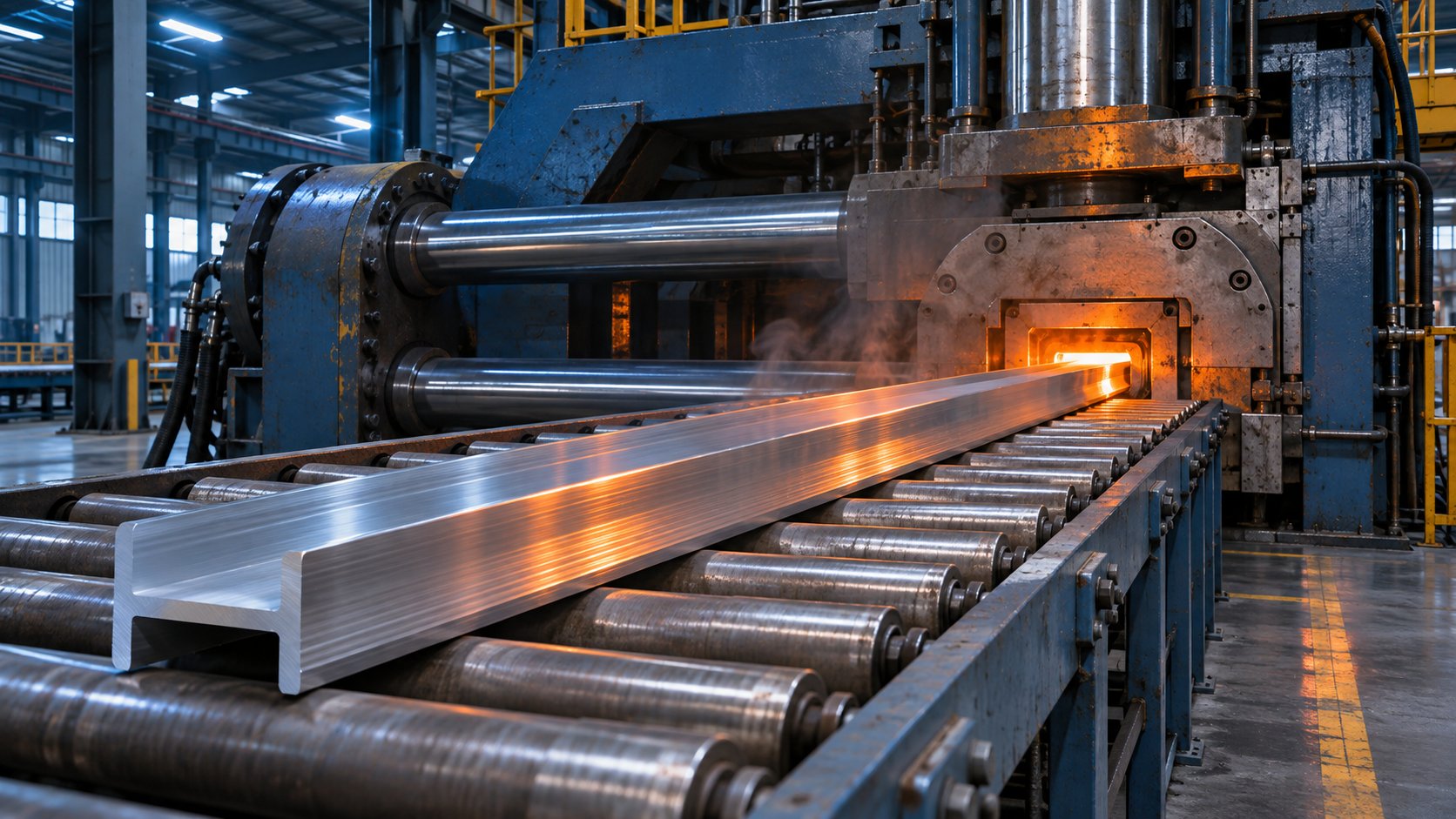
When you send a profile drawing to an extruder, they first check whether the shape will run well on the press and how fast it can run. For custom 6061 aluminum extrusions, the alloy matters as much as the shape. The copper and chromium that make 6061 stronger also make it harder to push through a die.
Extruders often rank alloys on a relative extrudability index, with 6063 set as the baseline of 100. The figures below are the values most often cited. Individual extruders publish slightly different numbers, so treat them as a ranking.
| Alloy | Relative Extrudability | What It Means at the Press |
|---|---|---|
| 6063 | About 100 | Baseline. Fast press speeds, thin walls and fine detail are practical. |
| 6061 | About 60 | Slower runs, higher die loads and less room for thin or intricate features |
| 7075 | About 10 | Very slow runs, practical mainly for simple, heavy shapes |
These numbers are relative indices, not absolute speeds. A rating of 60 does not mean 6061 runs at exactly 60 percent of the speed of 6063 on every press. It means 6061 is clearly harder to extrude. Lower extrudability means slower press speeds and more die wear. It also narrows the range of billet temperature and ram speed that still gives a sound profile with a clean surface.
Picture the same bracket profile quoted in both alloys. The 6061 quote usually comes back higher, and sometimes with a longer lead time. Two properties cause the difference:
The die design is also harder. The Aluminum Extruders Council explains that bearing length controls how fast metal flows through each part of the die opening. The goal is for every part of the profile to leave the die at the same speed. Balancing that flow takes more work in a stiffer alloy, and the slower runs and extra die correction both show up in the price.
A 6061 custom extruded aluminum profile follows the same design rules as any extrusion, with less margin for error. The limits below draw on the AEC's extrusion design guidance.
The type of shape decides the type of die. Solid shapes such as angles and channels run through solid, or flat, dies. These are the simplest tooling, and one flat die can have several openings to produce more than one profile per press stroke. Hollow shapes need a die with a built-in mandrel, such as a porthole, bridge or spider die. The metal splits around the mandrel supports and rejoins before it leaves the die. Porthole and pancake dies are the most common hollow designs and usually the cheapest to make.
A semi-hollow shape partly encloses a void. The die tongue that forms the void is large compared with the narrow gap that joins it to the rest of the die. That narrow neck has to carry the full extrusion pressure, and 6061's higher flow stress raises that load. For this reason, the AEC advises using as few hollows as possible.
For an ODM 6061 aluminum extrusion or any other custom project, these steps help avoid die revisions:
The extruder review can raise a bigger question. If the shape needs thin walls, fine detail and an even decorative anodized finish, 6061 may not be the right alloy.
Say your profile needs a crisp anodized finish and walls thinner than your extruder will run in 6061. Should you thicken the walls or change the alloy? Even in a guide about 6061, the honest answer is sometimes to change the alloy. Comparing 6061 vs 6063 aluminum, and 6061 vs 7075, shows where each one fits.
The strength figures below are minimum yield strengths in the T6 temper. They come from the same ASTM B221-12 table used in the property section, so confirm them against the current edition. Every other rating in the table is a qualitative comparison.
| Alloy | Strength Class | Extrudability | Achievable Wall Thickness and Detail | Surface Finish and Anodizing Quality | Weldability | Machinability | Typical Uses |
|---|---|---|---|---|---|---|---|
| 6061 | Medium-high. T6 yield 35.0 ksi min (ASTM B221) | About 60 | Moderate. Needs thicker walls and simpler detail than 6063 | Good for protective and hard-coat anodizing. Even decorative color is harder to hold | Good with filler metal. Strength drops near the weld | Very good in T6 and T6511 | Machine frames, fittings, marine and transport structures, machined parts |
| 6063 | Medium. T6 yield 25.0 ksi min (ASTM B221) | About 100 | Best of the three. Thin walls and intricate shapes are practical | Excellent. Smooth surface and uniform anodized color | Good. Strength drops near the weld | Fair to good. Softer, so chips tend to be gummier | Window and door frames, trim, heat sinks, furniture |
| 7075 | Highest of the three | About 10 | Limited to simple, thick-walled shapes | Fine for protective anodizing. Seldom chosen for decorative finishes | Poor by fusion welding | Very good in T6 tempers | Highly stressed aerospace and defense fittings, heavy bar |
In short, 6063 gives a smoother surface, thinner walls and more complex shapes. 6061 has about 40 percent more minimum yield strength in T6, and it machines more cleanly. The leaner chemistry that helps 6063 flow through a die also leaves it with less Mg2Si to strengthen it.
6063 is the most common extrusion alloy. Choose it when the part is mainly about appearance or shape:
6063 is commonly supplied in T5 and T6. T5 is cooled at the press and then artificially aged. A 6063 T6 aluminum extrusion is the stronger of the two, but it still falls well short of 6061-T6. ASTM B221 sets the 6063-T6 minimums at 30.0 ksi tensile and 25.0 ksi yield. The 6061-T6 minimums are 38.0 and 35.0 ksi. The specified minimums for 6063-T5 are lower again.
7075 makes sense when strength outweighs nearly every other requirement, as in highly stressed fittings. It comes with several costs. Its extrudability index of about 10 keeps profiles simple and thick-walled, and press runs are slow. Fusion welding is generally ruled out because the alloy cracks. Hollow shapes are difficult too, because the metal must rejoin inside a porthole die, and that step is still a research topic for 7075. Both the material and the extrusion cost more. If the design needs hollows, thin walls or welded joints, 7075 is the wrong alloy.
Forum threads on 6063 vs 6061 usually come back to strength, anodizing and extrusion cost. On strength, 6061 is stronger in the common heat-treated tempers, with 10 ksi more minimum yield strength in T6. On anodizing, 6063 gives the more even decorative color because of its leaner chemistry and smoother extruded surface. 6061 still anodizes well for protective and hard-coat purposes. On extrusion cost, 6063 is usually cheaper because it runs faster and wears the die less. The cost difference grows as the profile gets thinner or more complex.
Choosing 6061 for its machinability or weldability only pays off if the part is handled correctly after it leaves the press. A careless weld, for example, can bring T6 strength near the joint down to a fraction of what you paid for.
Start with 6063 when finish and geometry drive the design, move to 6061 when strength, machining or welding drive it, and consider 7075 only when strength outweighs everything else.
Extruded 6061 T6 aluminum is rarely used exactly as it arrives. It gets sawn, machined, perhaps bent, welded into a frame and anodized. Each of those steps depends on the temper you chose on the purchase order, and some of them undo it.
6061 machines best in its harder tempers. In T6 and T6511 the metal shears cleanly, so chips break into short curls and the surface stays bright. Softer O and T4 stock tends to smear. You'll see long, stringy chips and metal building up on the cutting edge, and that buildup tears the finish. The difference between a 6061 T6 bar and T6511 aluminum shows up later, as material comes off. T6511 has had its quench stresses evened out by stretching, so the part moves less as you cut deeper. These habits help with either temper:
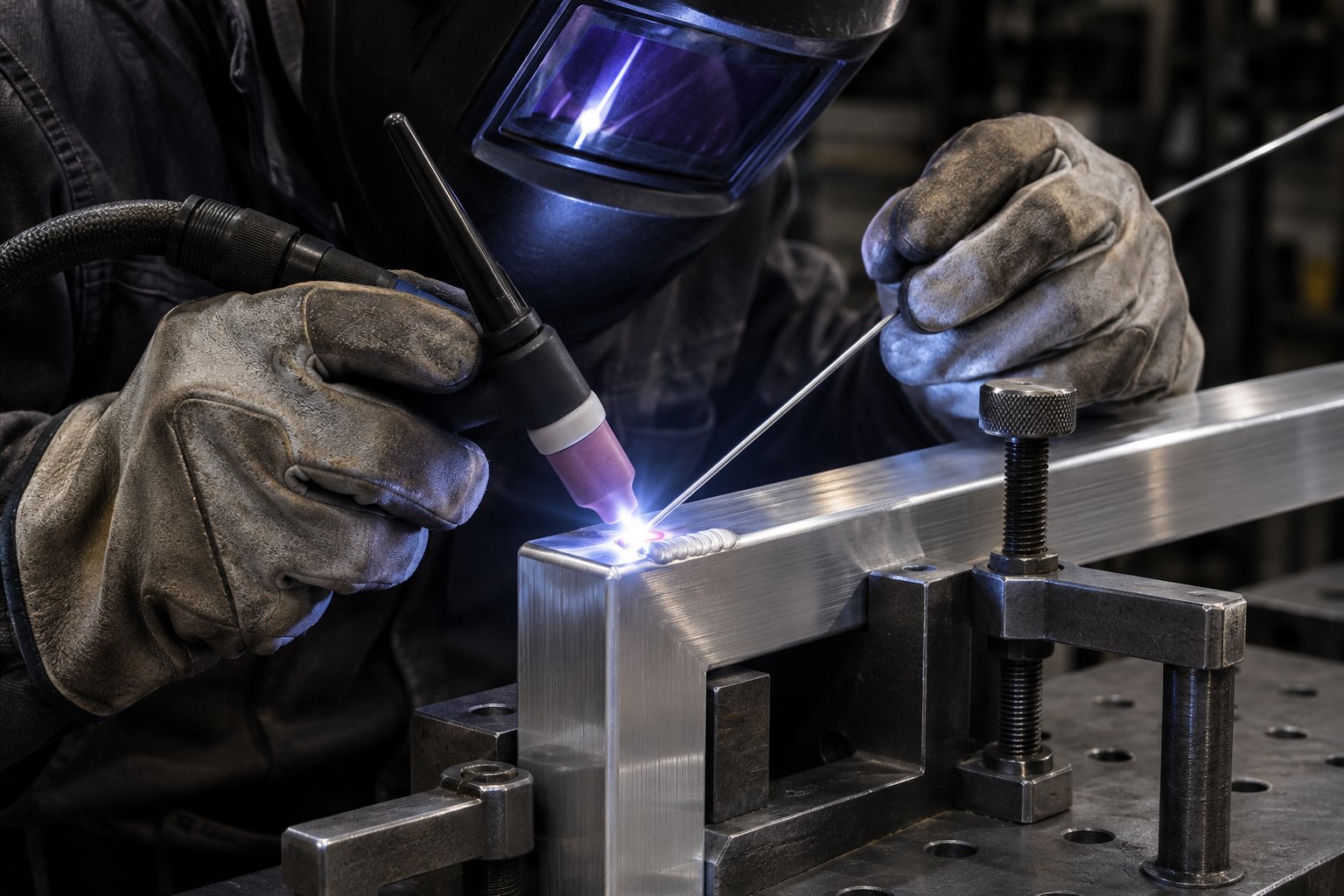
Welding heat reverses the aging that gave T6 its strength. In the heat-affected zone (HAZ), peak temperatures go above the solution heat-treatment temperature. The fine Mg2Si-type precipitates dissolve or coarsen, which is the overaging described in the chemistry section. This weld strength reference puts the as-welded HAZ yield of 6061-T6 at about 15 ksi. The ASTM B221 minimum for the parent metal is 35.0 ksi. The same source says AWS D1.2 tells designers to use T4 or O property values in that zone. It gives the HAZ width as 15 to 25 mm from the weld centerline, depending on heat input and thickness.
Size welded members with as-welded allowables from the Aluminum Design Manual or AWS D1.2. Parent-metal values overstate the strength near the weld. 6061 also needs filler metal. If you weld it without filler, the weld metal tends to crack as it solidifies. A suitable filler changes the weld chemistry enough to prevent that cracking.
4043 is aluminum with about 5 percent silicon, and 5356 is aluminum with about 5 percent magnesium. ESAB lists 6061 as a base alloy that either filler can weld. Its filler alloy comparison gives a transverse shear strength of 15 ksi for 4043 and 26 ksi for 5356, a difference that matters most in fillet welds. In butt joints, the softened HAZ usually limits strength whichever filler you use. The ratings below are general comparisons. Confirm each one against the AWS or filler manufacturer's selection chart for your joint, and qualify the welding procedure by testing.
| Property | 4043 (Al-5Si) | 5356 (Al-5Mg) |
|---|---|---|
| Hot-crack resistance | Higher | Good, but lower than 4043 |
| Weld puddle fluidity | Higher, wets and flows easily | Lower, stiffer puddle |
| As-welded shear strength | Lower (15 ksi transverse) | Higher (26 ksi transverse) |
| Ductility | Lower | Higher |
| Color match after anodizing | Poor, weld turns gray | Good |
| Post-weld heat treatment | Better suited, partly through magnesium picked up from the base metal | Not recommended |
6061 anodizes well for corrosion protection and for hard-coat wear surfaces. When decorative color has to match across many lengths, 6063 usually gives a more even result. Anodize after all welding and machining. Welding destroys the anodic layer near the joint, and holes drilled after anodizing leave bare metal.
Some sources imply that 6061 forms or welds well because it resists corrosion. These are separate properties. Corrosion resistance depends on the alloy's chemistry and its oxide film. Formability depends on temper and ductility. Weldability depends on cracking behavior and how the HAZ responds to heat. An alloy can rate well on one of these and poorly on another.
For forming, the temper decides most of the outcome. Hydro's bending guide says 6061 bends best when annealed, and that its bendability drops sharply in T4 and even more in T6. Where the process allows, the guide recommends bending in T4 and then aging to T6. T4 keeps aging slowly at room temperature, so springback can vary from batch to batch. If you have to bend T6, use a larger bend radius, because tight bends can crack on the outside of the bend. Hollow and asymmetric profiles also distort more, so mandrel rotary draw bending or stretch bending is often used for them.
For a typical welded and anodized frame, this order works well:
This sequence assumes a frame built from custom profiles. Many frames start from standard channels, angles and T-slot profiles. With those shapes, some of the steps above are never needed, while others become more important.
Many 6061 frames never need a custom die. A stock aluminum channel in 6061-T6 only has to be cut to length and drilled, so die design, die trials and minimum runs never come into it. Standard shapes still involve a choice, though. When you order a channel or an I-beam, you have to say which shape family you want: Aluminum Association or American Standard.
In a catalog photo the two families look much the same. The flanges are where they differ. American Standard shapes copy steel dimensions. Their flanges taper and their edges are rounded, so an aluminum member can replace a steel member in an existing design. Aluminum Association shapes were designed for aluminum. Their flanges are flat, the fillets between web and flange are generous, and the metal sits where it does the most structural work per pound. Metal Supermarkets adds that Aluminum Association I-beam flanges are straight and thicker than American Standard flanges, which makes connections and fitting easier.
The difference shows up most at bolted joints. On a tapered flange, a bolt head or nut sits at an angle unless you add a beveled washer. A flat flange gives fasteners, clamps and splice plates a square seat.
| Feature | Aluminum Association Shapes | American Standard Shapes |
|---|---|---|
| Origin of dimensions | Designed for aluminum | Copied from steel shapes |
| Flange profile | Flat, uniform thickness | Tapered, with rounded edges |
| Fillets | Generous | Follow steel proportions |
| Fastener seating | Square seat, no special washers | Beveled washers often needed |
| Weight efficiency | Material placed for an efficient strength-to-weight ratio | Steel proportions, not tuned for aluminum |
| Typical uses | Frames, brackets, base plates, machine parts, custom fabrication | Rafters, awnings, trailers, overhead supports, walkways, steel replacement |
Most structural 6061 is stocked in T6. Each common shape tends to do one job in a frame:
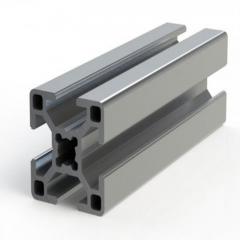
T-slot profiles have grooves along each face that hold T-nuts, so you can bolt a frame together without welding. They are used for workstations, machine guards and fixtures, and a T-slot frame can be taken apart and rebuilt when the layout changes.
T-slot profiles come in both alloys. 6063 is common for standard modular systems because slots, internal webs and center holes extrude more easily in it, and it anodizes more evenly. A 6061 T-slot aluminum profile makes sense where the frame needs more strength margin or machined features such as tapped holes and precision mounting faces. This T-slot alloy guide points out that many frames mix the two: 6063 for the main members, and 6061 for plates, motor mounts and brackets. The guide also notes that switching to 6061 does not make a long frame deflect less. Profile size, span and joint stiffness control deflection.
Mill-finish profiles are common for internal fixtures and guards, where cost matters more than appearance. Check connector compatibility before you mix parts from different sources. Slot width, slot depth and profile series vary by manufacturer, so two profiles with the same outside dimensions may not take the same T-nuts.
The part types in the table come from Hydro's 6061 overview and the beam uses listed earlier. That overview credits 6061 with good corrosion resistance to the atmosphere and to sea water.
| Industry | Typical Extruded Parts | Driving Property |
|---|---|---|
| Hydraulic and fluid power | Couplings, valves and fittings machined from extruded bar | Machinability, strength |
| Marine | Yacht structures, rails and framing | Corrosion resistance, weldability |
| Transportation and bicycles | Bicycle frames, motorcycle parts, automotive components, trailer frames | Strength-to-weight, weldability |
| Structural | Wide-span roof structures, bridge decks, walkways, overhead supports | Strength, standard shapes |
| Electrical | Electrical fittings and mounting hardware | Conductivity, machinability |
| Consumer products and furniture | Camera lens bodies, fishing reels, furniture frames | Machinability, anodizing |
In the electrical row, 6061 conducts well enough for fittings and hardware. Main current-carrying bus bar is usually made from an electrical-grade alloy instead.
Every part in that table reaches a supplier as a line on an order. A line that reads only "6061 channel, 3 in." leaves the supplier to guess the shape family, the temper, the tolerances and the paperwork. A complete drawing or RFQ removes those guesses.
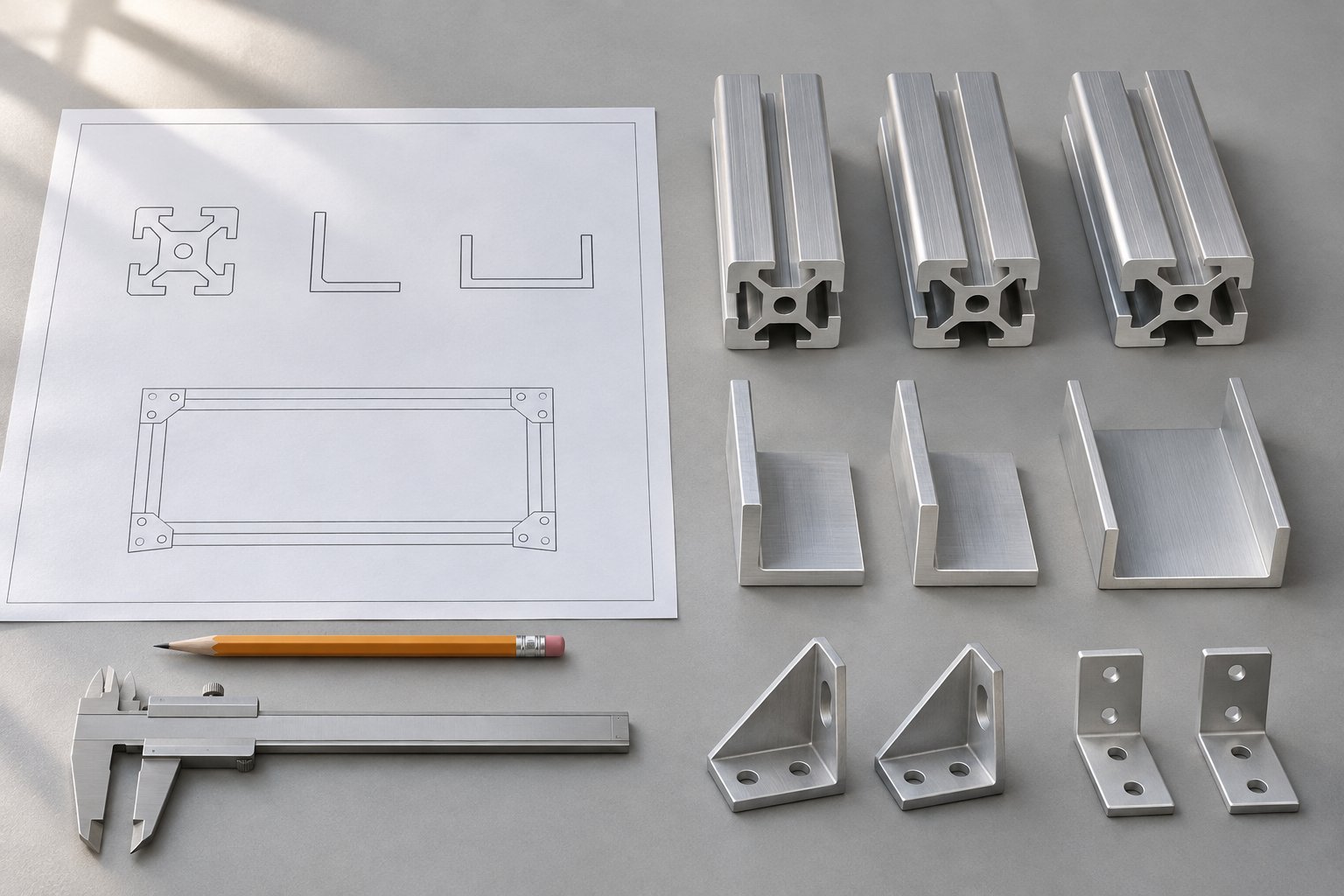
Have you ever sent one request to three suppliers and gotten back three quotes you couldn't compare? This usually happens because each supplier filled the gaps with its own assumptions. One quoted mill finish, one included machining, and one assumed a different tolerance standard. AL Circle's RFQ guide explains that missing information leaves a supplier two options. It can hold the quote while it asks questions, or it can price against guesses. A complete specification for 6061 aluminum extrusions removes those gaps before the first quote arrives.
Where you send the checklist depends on what you are buying: standard framing shapes, stock bar or a profile that needs its own die.
Specify the alloy, temper, governing standard and critical tolerances clearly, then send the same checklist with the RFQ to every supplier you ask to quote.
Both tempers are solution heat-treated and artificially aged. ASTM B221 holds them to the same strength limits: 38.0 ksi minimum tensile strength and 35.0 ksi minimum yield strength. They differ in stress relief. The 511 suffix means each length got a controlled permanent stretch after quenching, and minor straightening was allowed afterward to meet standard straightness tolerances. Plain T6 does not promise that stretch, so quench stresses can stay in the metal. Those stresses release as material is cut away, and long, thin or one-sided parts can bow. Choose T6511 for heavily machined or straightness-critical parts. Plain T6 is fine for members that are only sawn and drilled. Because the strength limits match, mills often certify T6511 stock to T6 as well. If you need a stretched product with no straightening afterward, the related temper is T6510.
The answer depends on what drives the design. 6063 is easier to extrude. Its relative extrudability is about 100, compared with about 60 for 6061. That lets it handle thin walls, fine detail and complex hollows at lower cost, and it gives a more even decorative anodized color. 6061 contains more magnesium, silicon, copper and chromium. In ASTM B221, that raises its T6 minimum yield strength to 35.0 ksi, against 25.0 ksi for 6063-T6, and 6061 machines with cleaner chips. A practical rule is to start with 6063 for architectural trim, decorative parts and lightly loaded framing. Move to 6061 for load-bearing frames, fittings and machined or welded parts. Many T-slot frames use both alloys, with 6063 for the main members and 6061 for plates, motor mounts and brackets.
ASTM B221 sets a minimum yield strength of 35.0 ksi (0.2% offset) and a minimum tensile strength of 38.0 ksi for 6061-T6, T6510 and T6511 extrusions. Minimum elongation is 8% for sections up through 0.249 in. thick and 10% for sections 0.250 in. and over. These are guaranteed minimums, so they are the correct inputs for strength calculations. Typical values published elsewhere are averages and read higher, which is why websites list different numbers. Confirm the figures against the current B221 edition and against the mill test certificate for each lot. Stiffness needs its own check. Young's modulus stays near 70 GPa (about 10,000 ksi) in every temper, so a part that deflects too much needs a deeper or closed profile, because a stronger temper will not fix it.
Yes. Welding heat dissolves or coarsens the fine precipitates that give T6 its strength. Near the joint, the heat-affected zone drops to roughly O or T4 levels. As-welded yield strength there is reported at about 15 ksi, compared with the 35.0 ksi minimum for the parent metal. The softened zone typically reaches about 15 to 25 mm (up to about 1 in.) on each side of the weld centerline, depending on heat input and thickness. Size welded members with as-welded allowables from the Aluminum Design Manual or AWS D1.2. Always use filler metal, because 6061 welded without filler tends to crack as it solidifies. 4043 filler resists hot cracking and suits parts that will be heat treated after welding. 5356 filler gives higher shear strength and a better color match after anodizing. Full solution heat treatment and re-aging can restore T6-level properties, but the whole weldment has to fit the furnace and the quench tank.
Start with a clear specification. It should state the alloy and temper in full (for example 6061-T6 or 6061-T6511) and name ASTM B221 as the governing standard. Call out ANSI H35.2 tolerances, with tight limits only on critical features. Add a profile drawing, cut lengths, surface finish, secondary operations and a requirement for a mill test certificate. Then match the supplier to the job. For bolt-together frames, guards and workstations, Shengxin Aluminium's industrial aluminum profile collection offers T-slot profiles, angles, custom channels and brackets in 6063-T5 and 6061-T6. It also offers cut-to-length, drilling and surface finishing to reduce in-house work. You still need to confirm load ratings, hole patterns, fasteners and connector fit for your project. T6511 is not listed, so ask the supplier directly if you need stress-relieved stock. Local distributors suit short lengths of standard bar and shapes, and custom extruders make profiles that need their own die.



 Інтернет-сервіс
 0086 136 3563 2360
 sales@sxalu.com
 +86 136 3563 2360
 Українська
 English
 français
 Deutsch
 русский
 español
 português
 العربية
 ไทย
 Việt